
Introduction
In 2026, your digital presence is your business. Whether you’re a startup trying to get noticed or an established company looking to scale, partnering with the right IT and digital marketing agency can be the difference between stagnation and explosive growth.
But with hundreds of agencies claiming to be “the best,” how do you actually choose? This guide breaks it down.
1. Define What You Actually Need
Before approaching any agency, be clear on your goals:
- Do you need a new website or a redesign?
- Are you looking for more organic traffic through SEO?
- Do you want to run paid ads on Google or Meta?
- Is your team struggling with manual processes that need CRM or DevOps automation?
Agencies specialise differently. Some are great at design but weak at SEO. Others run excellent ads but can’t build scalable software. Knowing your priority helps you find the right fit.
2. Look Beyond the Portfolio — Check Real Results
A beautiful portfolio means nothing without measurable outcomes. Ask any agency you’re evaluating:
- “What traffic growth did this client see after 6 months?”
- “What was the ROAS on that Google Ads campaign?”
- “How many leads did this website generate monthly?”
The best agencies speak in metrics — impressions, conversion rates, cost per lead, and ranking positions — not just design aesthetics.
3. Evaluate Their Own Digital Presence
This is one of the most overlooked indicators. If an SEO agency doesn’t rank well for its own keywords, that’s a red flag. If a web development company has a slow or outdated website, you already have your answer.
A reliable IT partner should be a living proof of what they sell.
4. Understand Their Process, Not Just Their Promise
Any agency can promise “Page 1 rankings in 30 days.” What separates credible agencies from scammers is a clear, logical process:
- SEO: Keyword research → On-page optimization → Content strategy → Link building → Reporting
- Web Development: Discovery → Wireframe → Development → Testing → Launch → Maintenance
- Ads: Campaign structure → Audience targeting → A/B testing → ROAS tracking
Ask for a process breakdown. If they can’t explain it clearly, they likely don’t have one.
5. Prioritise Communication and Transparency
One of the top reasons clients leave agencies is poor communication. Make sure the agency:
- Has a dedicated point of contact for your project
- Provides regular updates (weekly or bi-weekly reports)
- Shares access to tools and dashboards — Google Analytics, Search Console, Ads Manager
- Is reachable when you have questions or concerns
Transparency builds trust. Any agency that hides data or avoids specific questions should be avoided.
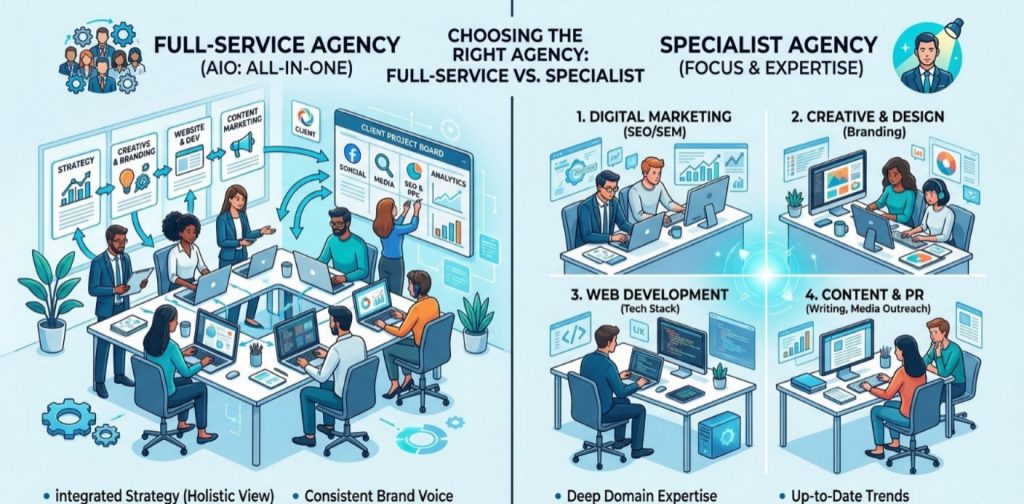
6. Consider Full-Service vs. Specialist Agencies
Full-service agencies (like Mag Cloud Solutions) handle everything — website, SEO, ads, CRM, DevOps — under one roof. This is ideal for businesses that want a single partner to manage their entire digital ecosystem without coordination headaches.
Specialist agencies focus on one area, like just SEO or just UI/UX. These work well when you already have a strong foundation and need deep expertise in a specific area.
For most small to mid-sized businesses, starting with a full-service agency is more efficient and cost-effective.
7. Don’t Choose Based on Price Alone
The cheapest option is rarely the best investment. A low-cost agency that delivers no results costs far more in time, opportunity, and frustration than one with a fair price and proven outcomes.
That said, expensive doesn’t automatically mean better. Look for value — what do you get for what you pay? Does the pricing include reporting, revisions, and ongoing support?
8. Ask About Post-Launch or Post-Campaign Support
A website that launches without ongoing maintenance will fall behind on speed, security, and SEO within months. Ask specifically:
- Do you offer ongoing maintenance plans?
- What happens if there’s a bug after launch?
- Will you monitor ad performance and optimise it continuously?
The best agencies treat your project as a long-term partnership, not a one-time transaction.
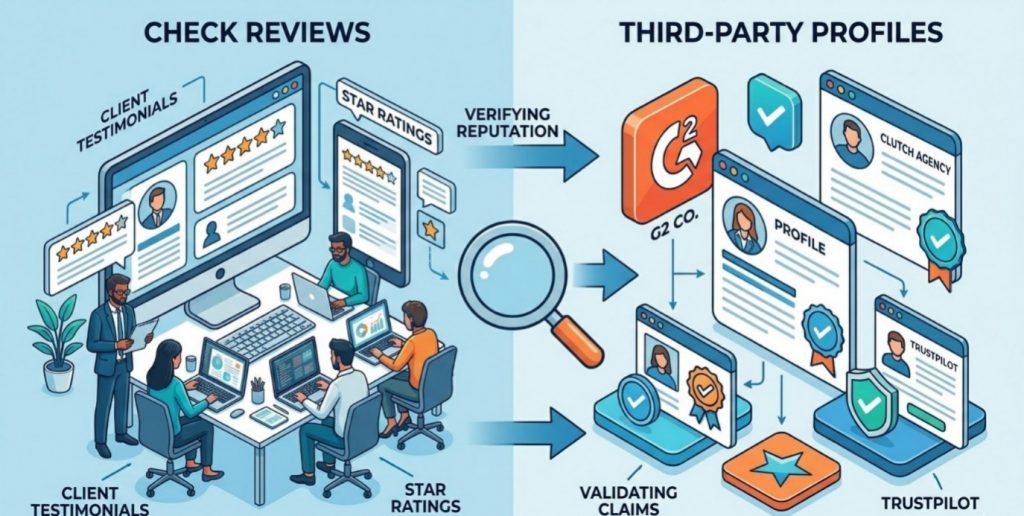
9. Check Reviews and Third-Party Profiles
Beyond the testimonials on their website (which any agency can curate), check:
- Google Reviews — Are they consistent and detailed?
- Clutch.co — Do they have verified reviews from real clients?
- Upwork or Freelancer — What’s their job success score?
Third-party validation is harder to fake and gives you a realistic picture of what working with them is like.
10. Start Small, Then Scale
If you’re unsure about committing to a long-term contract, ask for a trial project — a landing page, a one-month SEO report, or a small ad campaign. This gives you a risk-free way to evaluate their quality, communication, and delivery before going all in.
Final Thoughts
Choosing the right digital partner in 2026 is less about finding the flashiest agency and more about finding one that understands your business goals, communicates clearly, delivers measurable results, and supports you long after the project goes live.
If you’re looking for a team that checks all these boxes — from SEO and web development to CRM automation and performance marketing — Mag Cloud Solutions is ready to help businesses across India, UAE, the UK, and the USA grow with smart, scalable digital strategies.
FAQS
Look for an agency that understands your industry, communicates transparently, shows measurable results from past clients, and offers services aligned with your specific goals — whether that’s SEO, web development, paid ads, or CRM automation.
A full-service agency like Mag Cloud Solutions handles everything — website development, SEO, Google Ads, Meta Ads, DevOps, and CRM — under one roof. A specialist agency focuses on a single service area. Full-service is better for businesses that want one trusted partner managing their entire digital presence.
SEO typically shows noticeable results in 3 to 6 months depending on competition, website authority, and content quality. Paid ads like Google Ads or Meta Ads can generate leads within days of launching. A good agency will set realistic timelines and share progress through regular
No. The cheapest option often costs more in the long run due to poor results, wasted ad budgets, and lost time. Instead, focus on value — what you get for the price, including reporting, support, revisions, and measurable outcomes.
Ask about their process for your specific service, how they measure success, what tools they use, who will manage your account, how often they report, and whether they offer post-launch support. Always ask to see case studies or client results.