Both platforms can drive serious results — but they work in completely different ways. Here is everything you need to know before choosing where to spend your budget.
Table of Contents
- The Core Difference: Intent vs Interest
- Platform Overview: Google Ads vs Facebook Ads
- Head-to-Head Comparison
- Cost Comparison: Which is Cheaper?
- Targeting: Who Can You Reach?
- Which Industries Perform Better on Each?
- When to Use Google Ads
- When to Use Facebook Ads
- Should You Run Both?
- FAQs
1. The Core Difference: Intent vs Interest
This is the single most important concept to understand before choosing between the two platforms — and most people get it wrong.
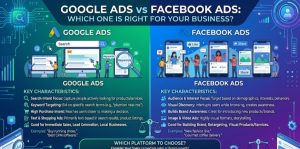
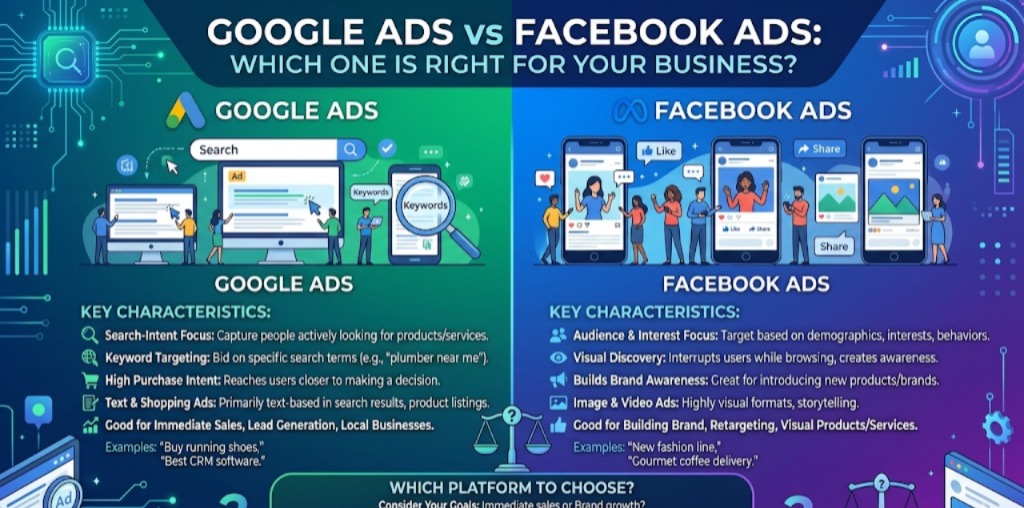
Google Ads = Intent-based advertising. You show ads to people who are actively searching for what you sell. They already want it — you just need to be visible at the right moment.
Facebook Ads = Interest-based advertising. You show ads to people who match a certain profile — age, interests, behaviours, life events. They are not searching for you. You are interrupting their feed and creating demand.
Neither is better than the other. They serve different stages of the customer journey. Google captures demand that already exists. Facebook creates demand where none existed before.
2. Platform Overview
8.5B = Google searches per day
3.2B = Facebook daily active users
35+ = Million websites in Google Display Network
2.1B = Instagram monthly active users (Meta network)
$237B = Google’s ad revenue in 2024
$134B = Meta’s ad revenue in 2024
Google dominates search advertising. Meta (Facebook + Instagram + Messenger + WhatsApp) dominates social advertising. Both are enormous ecosystems with mature tools, sophisticated automation, and proven ROI across industries.
3. Head-to-Head Comparison
| Factor | Google Ads | Facebook Ads |
|---|---|---|
| Ad Type | Text, Shopping, Display, Video | Image, Video, Carousel, Stories, Reels |
| Targeting basis | Keywords (search intent) | Demographics, interests, behaviours |
| Avg. CPC | ₹20–₹200+ (varies by industry) | ₹5–₹80 (generally lower) |
| Avg. CPM | ₹80–₹300 | ₹40–₹180 |
| Best for | High-intent buyers ready to purchase | Awareness, discovery, visual products |
| Audience size | Based on search volume | Massive — build any audience size |
| Creative requirement | Low — text ads work fine | High — visuals and video are essential |
| Learning curve | Moderate | Moderate to High |
| Remarketing | Yes (Display + Search) | Yes (very powerful) |
| E-commerce support | Google Shopping | Facebook/Instagram Shops, Catalog Ads |
| B2B effectiveness | High | Moderate (LinkedIn is better for B2B) |
| Minimum budget | No minimum | No minimum (~$1/day) |
4. Cost Comparison: Which is Cheaper?
Facebook Ads generally have a lower cost per click than Google Ads — but that does not mean they are cheaper overall. What matters is cost per conversion, not cost per click.
A Google Ads click may cost ₹150, but if that user was searching “buy leather wallet online” and converts at 5%, your cost per sale is ₹3,000. A Facebook click might cost ₹30, but if the user was casually scrolling and converts at 0.5%, your cost per sale is ₹6,000.
The real metric is Cost Per Acquisition (CPA) — not CPC. Always calculate how much it costs to get one paying customer, not just one click.
General Cost Benchmarks (India market)
| Industry | Google Ads Avg CPC | Facebook Ads Avg CPC |
|---|---|---|
| E-commerce | ₹15–₹60 | ₹8–₹35 |
| Education / Courses | ₹40–₹120 | ₹12–₹50 |
| Real Estate | ₹80–₹300 | ₹20–₹80 |
| Healthcare / Clinics | ₹30–₹150 | ₹10–₹50 |
| Finance / Insurance | ₹100–₹500+ | ₹30–₹100 |
| Local Services | ₹20–₹80 | ₹5–₹30 |
5. Targeting: Who Can You Reach?
Google Ads Targeting Options
Google targets based on what people are doing — their search queries, the websites they visit, their YouTube watch history, and their purchase intent signals. Key targeting types include keyword targeting (Search), audience segments (Display), customer match lists, and in-market audiences.
Facebook Ads Targeting Options
Facebook targets based on who people are — their age, gender, location, education, job title, interests, behaviours, life events, and connections. You can also build Custom Audiences from your existing customers and Lookalike Audiences to reach new people who resemble your best buyers.
Google Ads wins for
High purchase intent targeting
Keyword-level precision
In-market audience signals
Local search targeting
Facebook Ads wins for
Detailed demographic targeting
Interest and lifestyle segments
Lookalike audience creation
Retargeting with visuals
6. Which Industries Perform Better on Each?
Google Ads works best for
- Legal services
- Healthcare & clinics
- Home services (plumbers, electricians)
- B2B software & SaaS
- Financial services
- Auto & vehicle dealers
- Local businesses with search demand
- High-ticket products with clear intent
Facebook Ads works best for
- Fashion & apparel
- Beauty & skincare
- Food & beverage brands
- Online courses & coaching
- App installs
- Event promotion
- Impulse-purchase products
- New brand launches
7. When to Use Google Ads
Choose Google Ads when your product or service has existing search demand — meaning people are already typing queries related to what you sell. If someone is searching “best dentist near me” or “buy office chair online,” they are ready to take action. Google Ads puts you right in front of them at that critical moment.
Google Ads is also the stronger choice for B2B businesses, where buyers research solutions actively before making decisions, and for local service businesses that need to appear when people nearby search for their category.
Use Google Ads if: People are already searching for your product or service. You want to capture bottom-of-funnel buyers. You run a local business. You are in a high-intent category like legal, medical, or home services.
8. When to Use Facebook Ads
Choose Facebook Ads when your product needs to be seen to be wanted — when visual appeal drives the purchase decision. Fashion, food, home décor, beauty products, and lifestyle brands all perform exceptionally well because the product itself is the creative.
Facebook is also the right platform when you are building a brand from scratch or launching a new product that has no search volume yet. You cannot target Google keywords for something nobody is searching for — but you can target Facebook audiences by interest and lifestyle.
Use Facebook Ads if: Your product is visual and impulse-driven. You are launching a new brand or product. You want to build awareness at scale. You have strong creative assets (photos, videos). Your audience is defined by lifestyle or interest, not search behaviour.
9. Should You Run Both?
For most growing businesses — yes. The two platforms are complementary, not competitive. A proven strategy is to use Facebook Ads for top-of-funnel awareness and Google Ads for bottom-of-funnel conversion.
Someone sees your Facebook ad for a skincare product, becomes interested, then later Googles your brand name. Your Google Search ad captures that branded search. Without Google Ads, you might lose that conversion to a competitor who is bidding on your brand name.
The smart combo: Use Facebook to introduce your brand to cold audiences → use Google to catch them when they come back ready to buy. This full-funnel approach consistently outperforms either platform used alone.
Final Verdict
There is no universally “better” platform. Google Ads wins when demand exists and buyers are searching. Facebook Ads wins when you need to create demand and reach people based on who they are. The best advertisers do not choose one — they use both strategically to cover the full customer journey from awareness to conversion.
Start with the platform that matches your most urgent goal, build your skills and conversion data there, then layer in the second platform once you have a proven offer and creative assets.
FAQS
Google Ads or Facebook Ads? Google Ads is easier for beginners because users are already searching for your product. Facebook requires stronger creative assets and more audience testing to get results.
Facebook has a lower cost per click, but Google users have higher purchase intent. Always compare Cost Per Acquisition (CPA) — not just CPC — to find out which is truly cheaper for your business.
Yes — and most successful businesses do. Use Facebook for awareness and Google to capture users when they are ready to buy. The two platforms work best together.
Both work well. Google Shopping Ads capture buyers already searching for products. Facebook and Instagram Catalog Ads are better for product discovery and impulse purchases.
Google Ads is stronger for local businesses. When someone searches “plumber near me” or “salon in my city,” they are ready to hire — and Google puts you right in front of them.
Facebook can work for B2B lead generation, but Google Ads and LinkedIn Ads typically perform better for B2B. Business buyers actively search for solutions on Google rather than discovering them on social media.
For Google Ads, start with ₹500–₹1,000 per day. For Facebook Ads, ₹300–₹500 per day per ad set is a good starting point. Give either platform at least 30 days before judging results.
Facebook wins for demographic and interest-based targeting — age, gender, lifestyle, job title, and more. Google wins for intent-based targeting, reaching people based on what they are actively searching for.