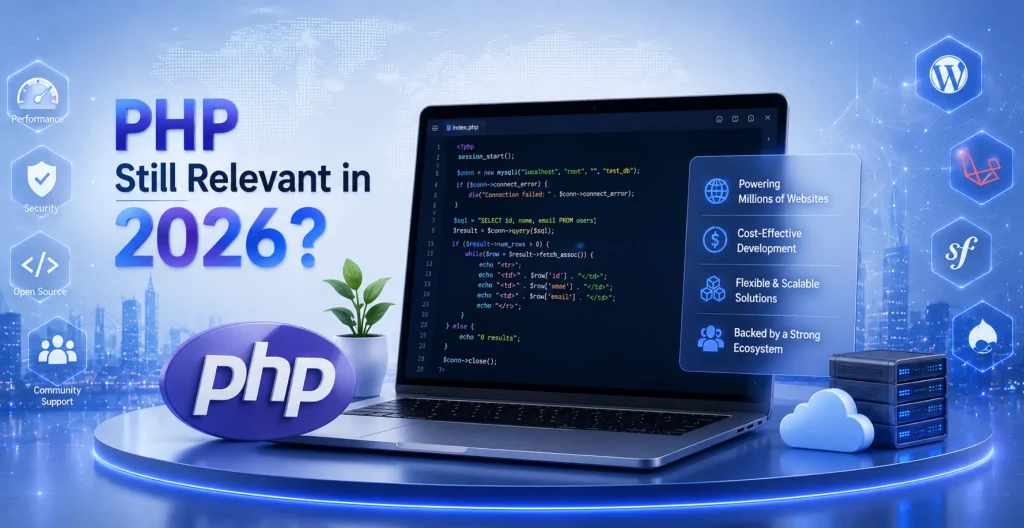
Web development technologies continue to evolve, with new programming languages, frameworks, and AI-powered coding tools attracting attention every year. Despite these changes, PHP remains an important technology for building and maintaining websites and web applications.
PHP is a server-side scripting language designed for web development. It can process requests, interact with databases, manage sessions, validate information, and generate dynamic content.
It powers a large ecosystem of applications, including WordPress websites and Laravel-based business systems.
For businesses, PHP offers a practical foundation for creating dynamic websites, integrating external services, and developing custom functionality.
This guide explains why PHP remains relevant in 2026 and how businesses can benefit from professional PHP development.
1. What Is PHP?
PHP is a server-side programming language used to build dynamic web applications.
When a visitor submits a form or opens a dynamic page, PHP code can process the request, retrieve information from a database, apply business rules, and return the appropriate response.
For example, an ecommerce website may use PHP to retrieve product information, calculate prices, validate order details, and save order records.
Unlike static HTML, which primarily describes the structure of a page, PHP can execute application logic on the server.
PHP is commonly used for:
- Business websites.
- Content management systems.
- Ecommerce applications.
- Customer dashboards.
- Membership platforms.
- API development.
- Database-driven applications.
- Custom administrative systems.
Its extensive ecosystem makes it useful for both new projects and the ongoing maintenance of existing websites.
2. PHP Powers WordPress Websites
WordPress is built primarily with PHP, which makes PHP knowledge valuable for advanced WordPress development.
Although users can build many pages using themes and visual page builders, custom requirements often involve server-side programming.
For example, a business may need a custom post type, a specialized search system, additional WooCommerce checkout validation, or a connection to an external CRM.
A PHP developer can use WordPress hooks, filters, and APIs to extend the platform while maintaining compatibility with its architecture.
PHP is also useful when troubleshooting theme conflicts, plugin errors, database queries, and server-side functionality.
However, custom WordPress development should follow established coding and security practices rather than modifying core files or relying on fragile workarounds.
3. PHP and Laravel for Custom Applications
Laravel is a PHP framework that provides a structured foundation for building web applications.
It includes tools and conventions for routing, database access, validation, authentication, queues, and other common development tasks.
Laravel can be used to build:
- Customer and vendor dashboards.
- Booking and appointment systems.
- Property listing platforms.
- CRM applications.
- Subscription-based services.
- Business management systems.
- Custom REST APIs.
For example, a property platform might allow users to create listings, upload photographs, manage inquiries, and purchase promotional placements.
Laravel can organize these features into maintainable application components.
However, framework selection should depend on the project’s requirements, available developer expertise, and long-term maintenance plans.
4. Database Integration With PHP
Many web applications depend on structured data stored in databases.
PHP can interact with database systems such as MySQL and MariaDB to retrieve, create, update, and delete records.
For example, a customer registration system may validate submitted information, check whether an account already exists, and create a user record.
A properly designed application must handle database operations safely.
Developers should use parameterized queries or appropriate database abstractions, validate input, enforce authorization, and avoid exposing sensitive information in error messages.
Database performance also matters. Poorly written queries, missing indexes, and unnecessary repeated requests can slow down an application as its data grows.
5. PHP for API Development and Integrations
Modern businesses often rely on multiple software systems.
A website may need to connect with payment providers, shipping services, CRM platforms, marketing tools, inventory applications, or external data sources.
PHP can communicate with these systems through APIs.
For example, a custom application might send a request to a payment provider, verify the resulting transaction through a secure callback, and update an order’s status.
Developers can also use webhooks to receive notifications when supported external events occur.
Reliable integrations require more than sending requests. They must handle authentication, timeouts, failed responses, duplicate events, data validation, and changes to external APIs.
These details are important for preventing inconsistent records and operational problems.
6. Is PHP Fast Enough for Modern Applications?
PHP can support many high-traffic websites and business applications when it is configured and developed appropriately.
Performance depends on several factors, including the hosting environment, database design, application architecture, caching, external dependencies, and workload.
A poorly optimized application can be slow regardless of the programming language.
Developers can improve PHP performance by optimizing database queries, avoiding unnecessary computation, using suitable caching, profiling slow operations, and selecting appropriate infrastructure.
For larger applications, background queues and asynchronous processing can help move time-consuming operations away from user-facing requests.
Performance should be measured under realistic conditions instead of relying on general assumptions about a language.
7. PHP Security Best Practices
Security should be built into every PHP application.
Important practices include:
- Validate and sanitize input according to its intended use.
- Use prepared statements or safe database abstractions.
- Apply authentication and authorization correctly.
- Escape output to prevent cross-site scripting.
- Protect sensitive actions against CSRF where applicable.
- Store secrets outside publicly accessible files.
- Use HTTPS and secure session settings.
- Keep PHP, frameworks, and dependencies updated.
- Log errors securely without exposing sensitive details.
Developers should also consider file-upload validation, rate limiting, access controls, and appropriate password hashing.
Security testing is especially important for applications that process payments, personal information, or confidential business data.
8. PHP and AI-Assisted Development
AI coding assistants can help PHP developers draft functions, explain unfamiliar code, prepare tests, and investigate error messages.
They can also accelerate learning for developers who are exploring frameworks such as Laravel.
However, AI-generated PHP code can contain outdated patterns, insecure queries, incorrect assumptions, or compatibility issues.
Developers should verify suggestions against the application’s actual requirements and the relevant documentation.
AI works best as an assistant to technical problem-solving rather than a replacement for understanding the codebase.
9. When Should a Business Choose PHP?
PHP may be a strong choice when a business needs a WordPress website, a WooCommerce store, a Laravel application, or custom server-side functionality.
It can also be appropriate for extending an existing PHP application, integrating external services, or modernizing a legacy system.
Before starting a project, businesses should evaluate required features, traffic expectations, integration needs, security requirements, and developer availability.
Choosing a technology that the team can maintain reliably is often more valuable than selecting a language solely because it is currently popular.
Conclusion
PHP continues to be relevant because it supports a broad ecosystem of content management systems, ecommerce platforms, frameworks, and business applications.
Its practical value comes from the ability to build dynamic websites, integrate databases, create APIs, and maintain established applications.
When combined with secure coding, suitable architecture, performance optimization, and regular maintenance, PHP can support reliable digital products.
Mag Cloud Solutions helps businesses with website development, PHP-based functionality, integrations, and custom web solutions.
Need a PHP developer for your next project?
Contact Mag Cloud Solutions to discuss your requirements.
Mag Cloud Solutions
Phone: +91 9536899899
Email: sales@magcloudsolutions.com
Website: https://magcloudsolutions.com/