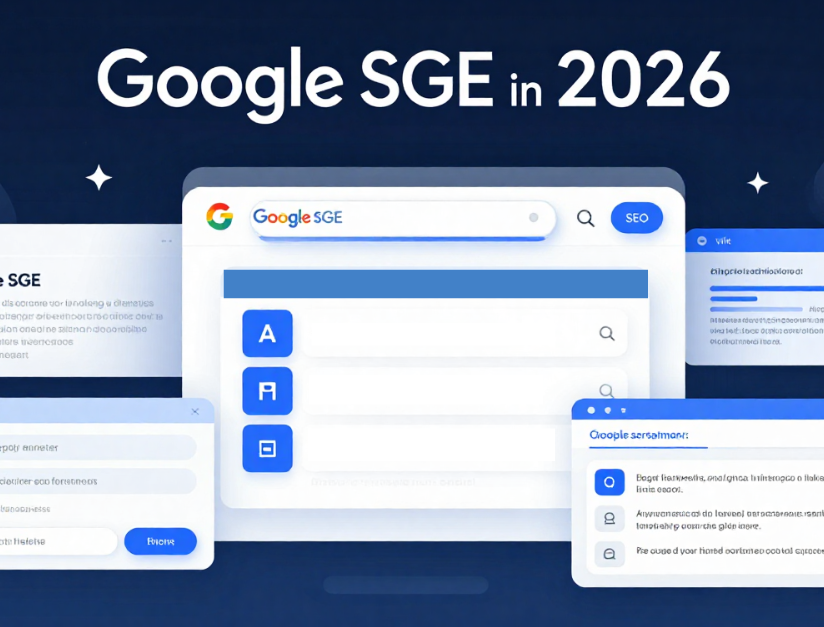
Search is no longer only about ranking pages.
With AI-driven experiences such as Search Generative Experience (SGE) from Google, search engines now generate answers directly inside the results.
For businesses and agencies like Mag Cloud Solutions, this shift changes how SEO must be planned, executed, and measured in 2026.
This guide explains—clearly and practically—how AI search is redefining SEO and what you should adapt now.
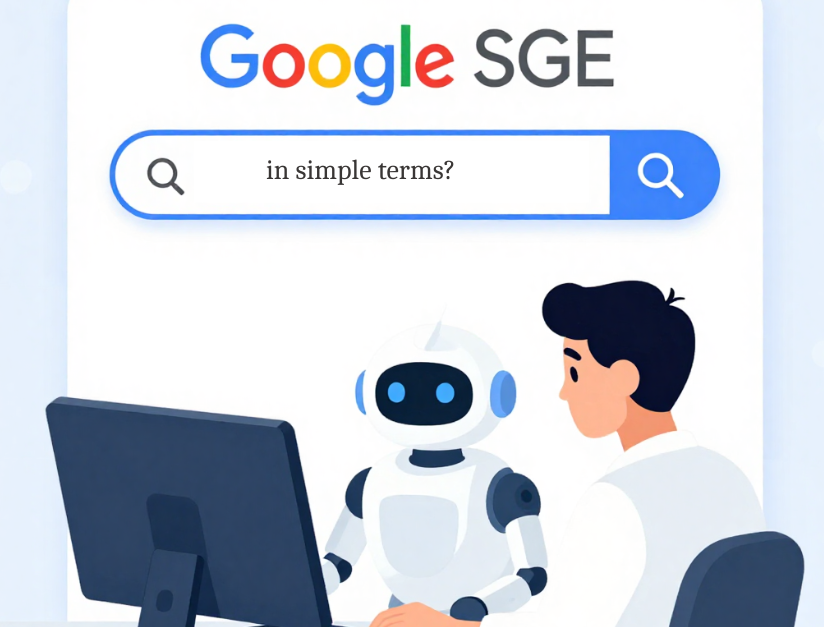
What is Google SGE in simple terms?
Google’s Search Generative Experience uses AI to:
- understand a user’s question,
- read and combine information from multiple websites,
- and present a summarized answer at the top of the search results.
Instead of only showing links, Google now tries to solve the user’s problem immediately.
This means your content is no longer competing only for rankings.
It is competing to become a trusted source for AI-generated answers.
The biggest change: SEO is shifting from ranking pages to being cited as a source
In traditional SEO, success meant:
- appearing on page one,
- improving click-through rate,
- and pushing users to your website.
In AI-driven search, success means:
- your content is selected,
- extracted,
- and used as part of the AI answer.
If your page is not clear enough for AI to safely quote, it may still rank—but it will not influence the generated result.
Why keyword-focused SEO is no longer sufficient
SGE does not rely on keyword matching alone.
It evaluates:
- whether your page directly answers a question,
- whether the explanation is complete and consistent,
- and whether your website shows topical credibility.
This is why many keyword-optimized pages are invisible in AI answers.
They were written to match phrases, not to explain concepts.
How SGE changes search intent interpretation
In 2026, Google interprets intent at a deeper level.
For example, when someone searches:
“digital marketing agency for real estate business”
SGE tries to understand:
- the industry context,
- the expected services,
- typical business problems,
- and decision-making factors.
If your content does not address those specific business needs, AI cannot confidently reuse it—even if your keyword placement is perfect.
Structure has become a major ranking and trust signal
AI systems rely heavily on structure to understand meaning.
Pages that perform better in SGE typically have:
- one clear main topic,
- direct explanations near the top,
- logically separated sections,
- step-by-step processes,
- and short answer-ready paragraphs.
In 2026, content structure is no longer a formatting decision.
It is an interpretation signal.

SGE favors explanation over promotion
One of the most important behavioural changes in AI search is its strong preference for neutral, informative content.
Overly promotional language reduces AI confidence.
Phrases such as:
- best company
- guaranteed results
- #1 agency
do not help SGE understand how a service actually works.
Instead, AI prioritises content that explains:
- what the service does,
- how it is delivered,
- what outcomes can realistically be expected,
- and who the service is suitable for.
Topic authority is replacing isolated keyword pages
SGE evaluates websites at a broader level.
It checks whether your website:
- consistently covers a subject,
- publishes related supporting content,
- and connects topics through internal linking.
A single optimized page is no longer enough.
Your website must demonstrate topical depth.
This is especially important for service businesses.
If you offer SEO, content strategy, technical optimisation and analytics services, your website must reflect all of these areas in connected and structured content.
Internal linking now directly supports AI understanding
In traditional SEO, internal links helped crawlers and users.
In AI search, internal links help build context.
They show AI:
- how topics relate to each other,
- which pages support a main service,
- and where your real expertise lies.
SGE uses this relationship mapping to decide whether your site can be treated as a reliable reference.
FAQs are becoming AI extraction points
In 2026, FAQ sections are no longer only for rich results.
They act as:
- short answer repositories,
- intent clarifiers,
- and trust signals.
SGE frequently extracts information from FAQ blocks because they:
- match real user questions,
- provide direct answers,
- and maintain consistent formatting.
For service pages and educational blogs, FAQs significantly increase reusability.
SEO performance is no longer measured only by clicks
One of the most important strategic changes is reporting.
SGE reduces clicks for many informational queries.
This means SEO success must now be evaluated through:
- impression visibility,
- brand mentions within AI answers,
- assisted conversions,
- and long-term trust signals.
Ranking alone does not represent actual visibility anymore.
What businesses must change in 2026
To adapt to AI-driven search like SGE, businesses should focus on:
- writing answer-first content instead of keyword-first content,
- redesigning service pages to clearly explain processes,
- building supporting articles around each core service,
- strengthening internal linking structures,
- and adding structured FAQ sections.
Most importantly, content teams must stop writing for algorithms and start writing for explanation.
Why this matters for digital marketing agencies
For agencies such as Mag Cloud Solutions, SGE changes client expectations.
Clients will no longer ask only:
“Can you rank my keywords?”
They will increasingly ask:
“Can my business appear inside AI answers?”
This requires a strategy that combines:
- technical structure,
- content clarity,
- topical authority,
- and intent-driven optimisation.
Final takeaway
Google SGE is redefining SEO in 2026 by shifting the goal from ranking pages to becoming a trusted source for AI-generated answers.
Websites that:
- clearly explain their topics,
- structure information for extraction,
- and demonstrate real topical expertise
will continue to gain visibility—even as traditional clicks decline.
In the AI search era, SEO is no longer about being found.
It is about being trusted enough to be used.

Google SGE is an AI-powered search experience that generates answers directly in search results by analysing and summarising information from multiple websites.
Google SGE is shifting SEO from ranking web pages to becoming a trusted source that AI can use to generate accurate and reliable answers.
Yes, websites can still rank in traditional search results, but they may receive less visibility if their content is not used inside AI-generated answers.
Content that provides clear explanations, direct answers, structured sections, step-by-step processes and relevant FAQs performs best in Google SGE.
No. Google SGE focuses more on intent, clarity, content structure and topical authority than on keyword placement alone.
Content structure is extremely important because SGE relies on clear headings, logical sections and short answer blocks to understand and extract information.
Yes. FAQs help AI systems identify precise answers to common user questions and improve the chances of content being selected for AI summaries.
Businesses should focus on answer-first content, strong internal linking, clear service explanations and building topical authority instead of only chasing keyword rankings.