In today’s digital world, businesses perform hundreds of repetitive tasks every day. Sending emails, updating spreadsheets, creating invoices, processing customer enquiries, sending notifications, updating CRM records, and moving information between different applications can consume a significant amount of time.
This is where automation becomes useful.
Automation allows businesses to configure software to perform repetitive tasks automatically, reducing the need for manual work. One of the popular tools for building these automated workflows is n8n.
Whether you are a business owner, developer, marketer, freelancer, or someone interested in improving productivity, understanding automation and n8n can help you build faster and more efficient workflows.
In this guide, we will explain what automation is, what n8n is, how it works, its benefits, common use cases, and how beginners can get started.
What Is Automation?
Automation is the process of using software, systems, or technology to perform tasks automatically with little or no human intervention.
For example, imagine that a customer fills out a contact form on your website. Normally, an employee might need to:
- Check the website for the new enquiry.
- Copy the customer’s information.
- Add the customer to a CRM.
- Send a confirmation email.
- Notify the sales team.
- Add the enquiry to a spreadsheet.
With automation, these steps can happen automatically.
A workflow could be configured so that when a customer submits the form, the system automatically saves the information in the CRM, sends an email to the customer, adds the information to Google Sheets, and sends a notification to the sales team.
The main idea is simple:
Trigger → Process → Action
Automation is especially useful for repetitive and rule-based tasks.
What Is Workflow Automation?
Workflow automation takes automation one step further by connecting multiple tasks and applications into a single process.
For example:
Website Form → CRM → Email → Google Sheets → Slack Notification
Instead of manually moving information between each application, an automation workflow can handle the entire process.
Businesses commonly use workflow automation for:
- Lead management
- Email marketing
- Customer support
- Sales processes
- Data entry
- Invoicing
- Notifications
- Reporting
- Ecommerce operations
- Social media workflows
- Internal business processes
The goal is not necessarily to remove humans from the process. Instead, automation can handle repetitive work so employees can spend more time on tasks that require decision-making, creativity, and communication.
What Is n8n?
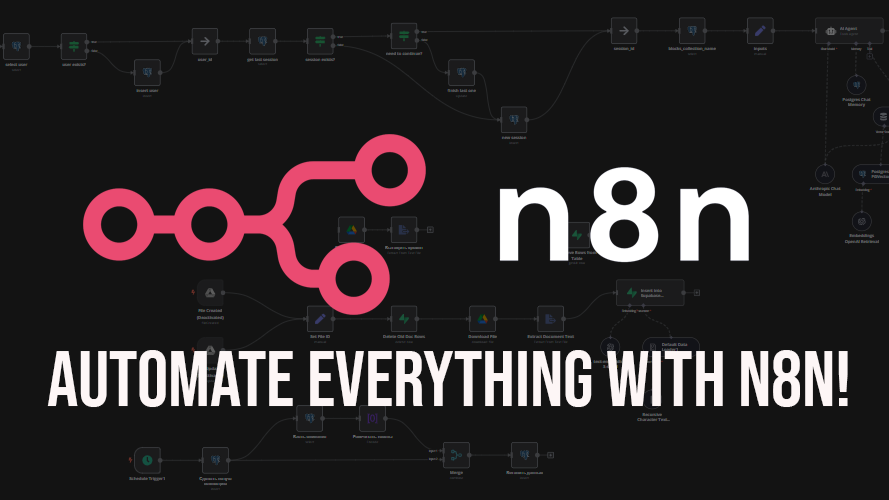
n8n is a workflow automation platform that allows users to connect different applications, services, APIs, and databases to automate processes.
The name is pronounced “n-eight-n.”
n8n provides a visual workflow builder where users can create workflows by connecting different nodes.
For example, you could create a workflow like:
WordPress → n8n → OpenAI → Gmail → Google Sheets
When a specific event occurs in WordPress, n8n can receive the information, process it, send it to another service, and perform additional actions automatically.
n8n is particularly useful because it supports both visual workflow building and more advanced customization using APIs, JavaScript, expressions, webhooks, and other developer-focused features.
How Does n8n Work?
n8n workflows are generally made up of different nodes.
Each node performs a specific function.
For example:
- A webhook node can receive information from a website.
- A Google Sheets node can read or write spreadsheet data.
- A Gmail node can send emails.
- A MySQL node can interact with a database.
- An HTTP Request node can communicate with an external API.
- A Code node can execute custom logic.
These nodes can be connected together to create an automated workflow.
A Simple Example
Suppose you have a website contact form.
A basic n8n workflow could look like this:
Webhook → Check Data → Google Sheets → Send Email → Notify Team
Here is what happens:
Step 1: Webhook
The website sends customer information to an n8n webhook.
Step 2: Data Processing
n8n checks the information and determines whether the required fields are available.
Step 3: Google Sheets
The customer’s name, email address, phone number, and message are added to a spreadsheet.
Step 4: Email
An automatic confirmation email is sent to the customer.
Step 5: Notification
The sales team receives a notification about the new enquiry.
Once configured, this workflow can run automatically whenever a new enquiry is received.
What Makes n8n Different?
There are many automation platforms available, but n8n is popular among developers and technical teams because it provides significant flexibility.
One important feature is its ability to work with APIs and custom logic.
If a particular application does not have a ready-made n8n integration, you can often communicate with it through an API using an HTTP Request node.
This makes n8n useful for businesses with custom websites, internal systems, databases, and software applications.
n8n can also be self-hosted, which can provide businesses with greater control over their workflow environment and data.
Common n8n Automation Examples
n8n can be used for many different business processes.
1. Lead Management
When someone submits a website enquiry:
Website → n8n → CRM → Email → Sales Notification
The lead can automatically be added to the CRM and the sales team can be notified immediately.
2. Ecommerce Automation
For an ecommerce business, n8n can connect different systems involved in order processing.
For example:
New Order → Check Payment → Update Database → Notify Team → Send Customer Email
This can reduce repetitive administrative work.
3. Email Automation
Businesses can automate email notifications based on different events.
For example:
New Customer → Add to CRM → Send Welcome Email
Or:
New Support Request → Create Ticket → Notify Support Team
4. Google Sheets Automation
Many businesses use spreadsheets to manage data.
n8n can automatically add, update, or retrieve information from Google Sheets.
For example, whenever a new lead is received, n8n can automatically add the lead to a spreadsheet.
5. WordPress Automation
n8n can also be connected with WordPress.
For example:
New WordPress Form Submission → n8n → CRM → Email → Notification
It can also be used to connect WordPress with external APIs, databases, spreadsheets, and other business tools.
6. AI Automation
One of the interesting uses of n8n is connecting AI services with business workflows.
For example:
Customer Enquiry → AI Analysis → Identify Category → Generate Response → Send Email
AI can be used inside an automation workflow to summarize information, classify text, generate content, extract data, or assist with customer support processes.
Benefits of Using Automation and n8n
Automation can provide several benefits to businesses.
Saves Time
Employees do not have to repeatedly perform the same manual tasks.
Reduces Manual Errors
Automated workflows can follow predefined rules consistently, reducing errors caused by repetitive data entry.
Improves Response Time
Automated notifications and emails can be triggered immediately when an event occurs.
Connects Different Applications
n8n can act as a bridge between different systems, allowing applications to exchange information.
Supports Custom Workflows
Businesses can create workflows according to their specific processes instead of relying only on predefined automation templates.
Scales With the Business
As the number of customers, orders, leads, or enquiries increases, automation can help businesses handle higher volumes without increasing every manual task.
Is n8n Only for Developers?
No.
n8n provides a visual workflow editor, so beginners can build many workflows without writing large amounts of code.
However, having technical knowledge can be very helpful.
Developers can use features such as:
- APIs
- Webhooks
- JavaScript
- HTTP requests
- JSON
- Database queries
- Authentication
- Custom logic
This makes n8n suitable for both non-technical users and developers, depending on the complexity of the workflow.
A beginner might create a simple workflow connecting Gmail and Google Sheets, while a developer could build a much more advanced workflow involving multiple APIs, databases, AI services, and custom business logic.
What Is an n8n Workflow?
An n8n workflow is a collection of connected nodes that perform a specific automated process.
For example:
Trigger → Get Data → Process Data → Check Condition → Perform Action
The trigger starts the workflow.
The workflow then processes the information and performs the required actions.
Triggers can include events such as:
- A webhook request
- A scheduled time
- A new database record
- A new form submission
- An application event
Once triggered, the workflow can execute multiple steps automatically.
How Can a Business Start With n8n?
The best approach is to start with one repetitive business task.
Look for a process that:
- Happens frequently
- Requires manual data entry
- Involves multiple applications
- Follows predictable rules
- Takes employees significant time
For example, if your team manually copies website enquiries into a spreadsheet every day, that could be a good candidate for automation.
Start with a simple workflow and test it carefully before automating more important business processes.
It is also important to consider security, authentication, error handling, data privacy, and monitoring when building production workflows.
Conclusion
Automation is becoming an important part of modern business operations. Instead of manually performing repetitive tasks, businesses can use software to connect systems and execute predefined processes automatically.
n8n is a powerful workflow automation platform that can connect websites, APIs, databases, CRM systems, spreadsheets, email services, AI tools, and many other applications.
For beginners, n8n provides a visual way to understand and build automation. For developers, it offers additional flexibility through APIs, webhooks, custom code, and advanced workflow logic.
The best way to understand n8n is to start with a small real-world problem and build a simple workflow around it. Once you understand triggers, nodes, data, conditions, and actions, you can gradually create more advanced automations.
As businesses continue to use more digital tools, the ability to connect these systems and automate repetitive processes can become a valuable part of improving productivity and operational efficiency.