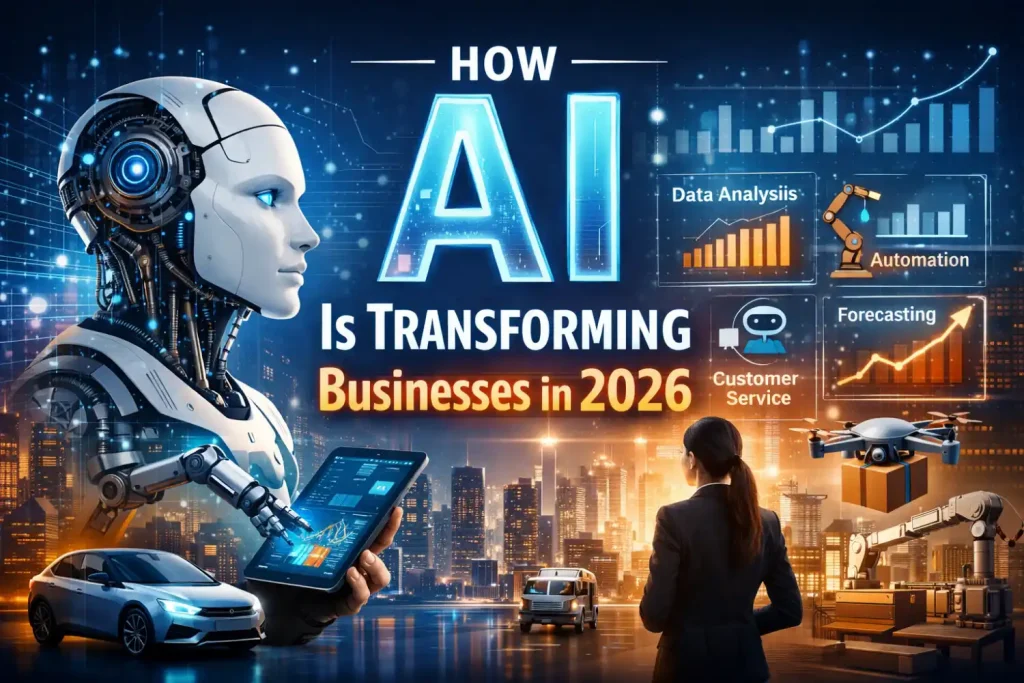
Artificial intelligence (AI) is changing the way businesses operate, communicate with customers, and manage everyday tasks. From small startups to established companies, organizations are exploring AI-powered tools to improve productivity, reduce repetitive work, and make better business decisions.
In 2026, AI is no longer limited to advanced research laboratories or large technology companies. Businesses can use AI writing assistants, chatbots, workflow automation platforms, predictive analytics, and intelligent software integrations to solve real-world problems.
However, successful AI adoption involves more than simply purchasing a tool. Companies need to identify the right use cases, protect their data, and ensure that automated processes deliver reliable results.
In this guide, we explore how AI is transforming businesses and how companies can use it effectively.
1. Automating Repetitive Business Tasks
Many businesses spend hours completing repetitive activities, including transferring information between applications, organizing customer inquiries, preparing reports, and sending follow-up emails.
AI and workflow automation can reduce the amount of manual work required for these processes.
For example, a business can create an automated workflow that receives a website inquiry, records the customer’s details in a CRM, sends a confirmation email, and notifies the sales team.
Tools such as n8n allow businesses to connect different applications and build automated workflows. AI models can also be integrated into these workflows to classify inquiries, summarize messages, or generate initial responses.
Automation does not mean removing human involvement from every process. Instead, it allows employees to focus on activities that require creativity, judgment, and personal communication.
2. Improving Customer Support With AI
Customer expectations continue to grow. People want quick answers, clear information, and convenient ways to contact businesses.
AI chatbots can help organizations respond to common questions about services, pricing, delivery policies, and business hours. When properly configured, they can provide assistance outside normal working hours.
A website chatbot can also collect important information before forwarding a complex inquiry to a human support representative.
For example, an ecommerce business might use an AI assistant to answer questions about product specifications, shipping policies, and order procedures.
However, chatbots must be designed carefully. They should avoid inventing answers, respect customer privacy, and provide an option to contact a real person when necessary.
The best customer support systems combine automated assistance with human expertise.
3. Making Better Business Decisions
Businesses generate information through website analytics, sales platforms, customer relationship management systems, and marketing campaigns.
Analyzing this information manually can be time-consuming, especially when data is spread across multiple applications.
AI-powered analysis can help identify patterns, summarize reports, categorize feedback, and highlight potential areas for improvement.
For example, an online store can analyze sales trends to understand which products receive more attention. A marketing team can examine campaign results to identify which channels generate valuable leads.
These insights can support decision-making, but AI-generated conclusions should be checked against reliable data. Businesses should not treat predictions as guaranteed outcomes.
4. AI in Website Development
AI is also influencing how websites and web applications are planned, designed, and developed.
Developers can use AI coding assistants to generate initial code, explain unfamiliar functions, identify possible errors, write documentation, and support testing.
AI tools can help with content planning, accessibility reviews, and ideas for improving website user experience.
For WordPress websites, AI can assist with content workflows, customer support integrations, and selected administrative tasks. Shopify businesses can explore AI tools for product descriptions, customer communication, and store management.
Nevertheless, AI-generated code still requires technical review. Security vulnerabilities, incorrect business logic, compatibility issues, and performance problems can occur if code is used without proper testing.
Experienced developers remain important for architecture, integrations, debugging, security, and long-term maintenance.
5. Personalizing Marketing and Customer Experiences
Customers are more likely to engage with businesses when information is relevant to their needs.
AI can help marketing teams organize audiences, analyze customer behavior, generate content ideas, and create different versions of marketing messages.
For example, a company might use customer preferences and purchase history to recommend relevant products, provided it has the appropriate permissions and privacy safeguards.
AI can also support email marketing by helping businesses draft newsletters, classify incoming inquiries, and plan follow-up campaigns.
Personalization should always provide genuine value. Excessive automation, irrelevant messages, and intrusive data collection can damage customer trust.
6. Reducing Costs Without Compromising Quality
AI can help businesses reduce the time spent on certain administrative and operational tasks. This may improve efficiency and allow existing teams to handle more work.
However, AI is not automatically cheaper than a manual process. Companies should consider subscription fees, API usage, development costs, maintenance, staff training, and the time needed to check results.
The most effective approach is to begin with a specific business problem and measure the results.
For example, a company can track how much time employees spend processing inquiries before and after implementing automation. It can then compare the savings with the total cost of operating the system.
7. Why Businesses Need a Clear AI Strategy
Implementing too many AI tools without a clear purpose can create confusion, duplicate work, and unnecessary expenses.
Before adopting AI, businesses should:
- Identify repetitive tasks that consume significant time.
- Select tools that integrate with existing systems.
- Review data privacy and security requirements.
- Test workflows using realistic scenarios.
- Establish human approval for important decisions.
- Measure accuracy, time savings, and overall business value.
Starting with a small project makes it easier to understand the benefits and limitations before expanding automation across the organization.
Conclusion
Artificial intelligence is creating new opportunities for businesses to improve productivity, strengthen customer support, analyze information, and streamline operations. Its greatest value comes from solving practical problems rather than adopting technology simply because it is popular.
Businesses that combine AI tools with reliable software, secure integrations, and human expertise can build more efficient digital operations.
At Mag Cloud Solutions, we help businesses explore website development, ecommerce solutions, and workflow automation tailored to their needs.
Want to improve your business with modern digital solutions?
Contact Mag Cloud Solutions to discuss your project.
Mag Cloud Solutions
Phone: +91 9536899899
Email: sales@magcloudsolutions.com
Website: https://magcloudsolutions.com/