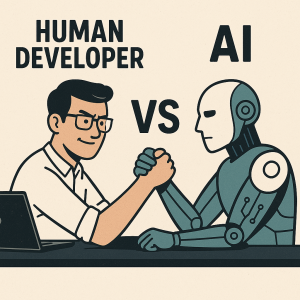
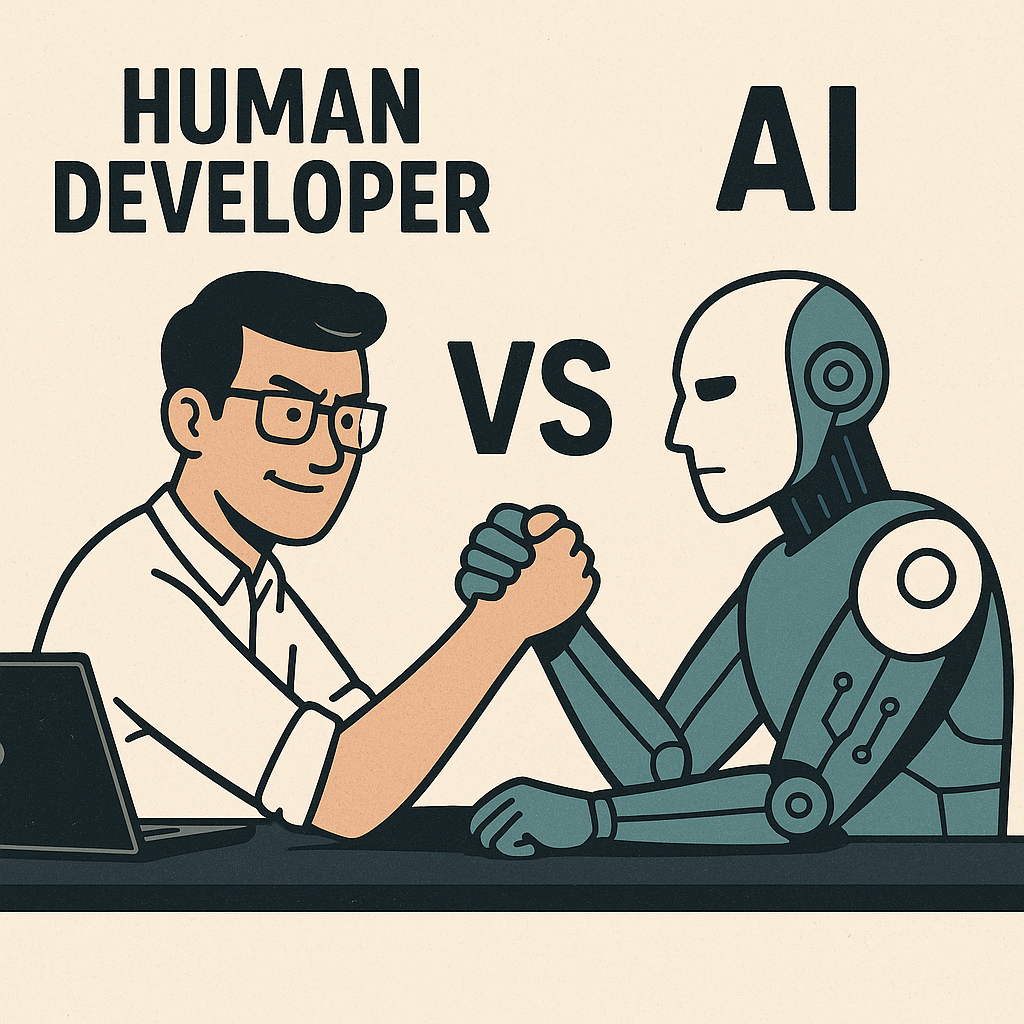
Artificial intelligence is changing the software development industry. AI-powered coding assistants can generate code, explain programming concepts, identify possible bugs, and help developers complete certain tasks more quickly. As these tools become more capable, an important question arises: will AI eventually replace software developers?
The answer is more complicated than a simple yes or no.
AI can automate parts of software development, but building reliable software involves much more than writing code. Developers must understand business requirements, design application architecture, protect sensitive information, integrate external services, test functionality, and maintain applications after launch.
Rather than viewing AI and developers as direct competitors, businesses should understand how the two can work together.
1. What Can AI Do in Software Development?
AI coding tools can assist developers throughout the software development process.
Generate code
AI can produce initial code for website sections, forms, database queries, API requests, and common programming tasks. Developers can use these suggestions to accelerate implementation.
For example, a developer building a PHP application may ask an AI assistant to create a basic validation function or explain how a particular Laravel feature works.
However, generated code must be reviewed before it is used in a production environment.
Debug programming errors
Developers can provide error messages and relevant code to an AI assistant to receive possible explanations and suggested fixes.
This can be particularly useful when troubleshooting unfamiliar frameworks or understanding complicated errors.
Nevertheless, AI may misunderstand the underlying problem or recommend a fix that addresses the symptom without solving the root cause.
Write documentation and tests
AI can help create technical documentation, suggest test cases, and identify situations that developers may have overlooked.
These capabilities can improve development workflows when combined with proper testing and human verification.
2. What AI Still Struggles to Do Reliably
Despite its capabilities, AI has limitations that matter in real-world projects.
Understanding business requirements
Clients do not always provide complete specifications. A developer may need to ask questions, identify missing information, and clarify how a feature should behave.
AI can help organize requirements, but it cannot independently guarantee that its interpretation matches the client’s expectations.
Making architectural decisions
A software application may need to support thousands of users, connect multiple services, follow specific security requirements, and accommodate future business changes.
Choosing the right architecture requires evaluating trade-offs involving performance, cost, maintainability, and scalability.
AI can recommend approaches, but developers must assess whether those recommendations are appropriate for the actual project.
Managing complex debugging
A problem may originate from a database, hosting configuration, caching layer, third-party API, or interaction between several plugins.
Resolving such issues requires investigation, testing, and an understanding of the complete system.
AI-generated suggestions may help, but they are not a substitute for reliable diagnosis.
3. AI vs. Human Developers: Key Differences
| Area | AI tools | Human developers |
|---|---|---|
| Code generation | Generate code quickly | Review and implement suitable solutions |
| Requirements | Help summarize instructions | Clarify business needs and priorities |
| Debugging | Suggest possible fixes | Investigate and verify root causes |
| Security | Identify some potential issues | Design and validate security controls |
| Architecture | Recommend possible designs | Evaluate trade-offs and long-term needs |
| Communication | Draft messages and documentation | Manage expectations and client relationships |
| Accountability | Operate within configured systems | Take responsibility for engineering decisions |
AI is useful for accelerating specific activities. Human developers provide the broader technical judgment required to deliver complete, maintainable products.
4. How AI Is Changing WordPress Development
WordPress developers can use AI to generate content ideas, assist with PHP snippets, explain hooks and filters, and troubleshoot certain plugin or theme problems.
AI may also help with repetitive tasks such as preparing initial page structures, writing documentation, or creating draft test scenarios.
However, custom WordPress projects often involve unique requirements.
A website might need a custom post type, advanced search, WooCommerce checkout modifications, CRM integration, or a carefully designed membership system. Each feature must work with the existing theme, plugins, database, and hosting environment.
Copying AI-generated code directly into a live WordPress website without reviewing it can introduce security vulnerabilities or break existing functionality.
Professional developers should use staging environments, backups, code reviews, and appropriate testing procedures.
5. How AI Is Changing PHP and Laravel Development
AI assistants can help PHP and Laravel developers write controllers, understand Eloquent relationships, draft migrations, generate validation rules, and explore API integration options.
They can also help developers understand framework documentation and learn unfamiliar programming techniques.
However, Laravel applications frequently include authentication, authorization, payment processing, database relationships, queues, and complex business rules.
Incorrect assumptions in these areas can create serious problems. A generated controller may work in a simple demonstration but fail when handling concurrent requests, unauthorized access, or unexpected input.
Developers must understand the framework rather than relying entirely on generated code.
6. Will AI Reduce Developer Jobs?
AI may reduce the time needed for certain routine programming tasks. This could change hiring requirements and increase expectations around productivity.
Some businesses may need fewer hours for straightforward implementation work, while demand may grow for developers who can integrate AI into existing systems, maintain complex applications, and solve difficult technical problems.
The effect will vary by industry, company, project complexity, and the pace of AI adoption.
Developers who rely only on repetitive coding may face greater pressure to adapt. Those who combine programming knowledge with communication, problem-solving, security awareness, and system design may be better positioned to benefit.
AI does not guarantee job security for experienced developers, but neither does it make technical expertise irrelevant.
7. Skills Developers Should Learn in 2026
Developers can prepare for an AI-assisted future by strengthening the skills that support dependable software delivery.
Important areas include:
- Programming fundamentals in PHP, JavaScript, and other relevant languages.
- Framework knowledge, including Laravel and modern frontend tools.
- API development and third-party integrations.
- Database design and query optimization.
- Authentication, authorization, and application security.
- Git, testing, debugging, and deployment workflows.
- AI coding assistants and workflow automation platforms such as n8n.
- Requirements gathering and clear communication with clients.
Learning how to evaluate AI-generated code is just as important as learning how to generate it.
8. How Businesses Should Use AI and Developers Together
Businesses should identify where AI can improve efficiency without reducing software quality.
AI can support repetitive development activities, while developers focus on project planning, complex functionality, security, testing, and business-specific decisions.
A practical workflow might involve using AI to draft a function, having a developer review the implementation, testing it in a staging environment, and monitoring the feature after deployment.
This approach combines speed with technical oversight.
Conclusion
AI is transforming software development, but replacing every developer is not a realistic description of what these tools currently do. AI can generate code and assist with routine tasks, while dependable software still requires requirements analysis, architecture, testing, security, and maintenance.
The future belongs to development teams that understand both programming fundamentals and the effective use of AI tools.
At Mag Cloud Solutions, we focus on website development and digital solutions designed around real business requirements.
Need a website or custom web application?
Contact Mag Cloud Solutions to discuss your project.
Mag Cloud Solutions
Phone: +91 9536899899
Email: sales@magcloudsolutions.com
Website: https://magcloudsolutions.com/