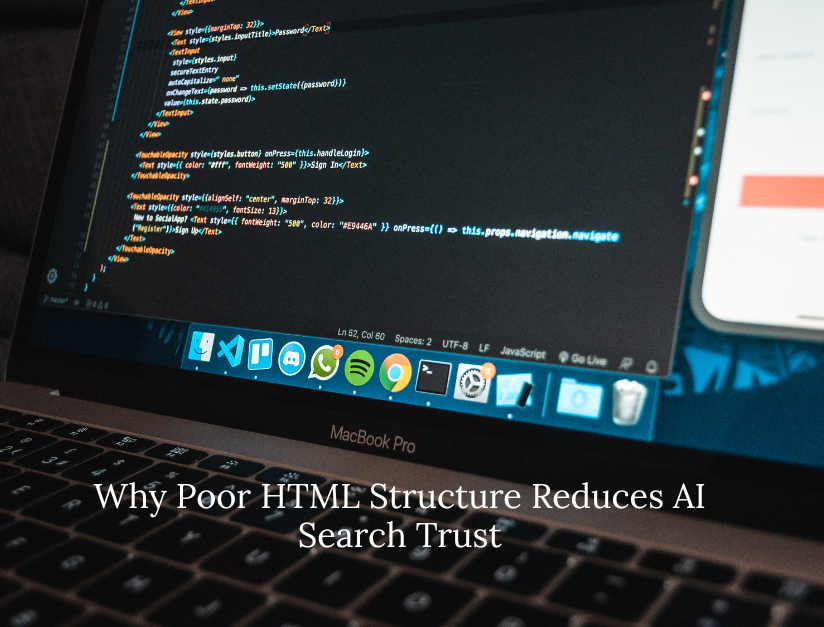
Today, search visibility is no longer only about rankings. AI-powered search systems decide which pages they can trust enough to use as answers.
And one of the biggest hidden reasons websites fail in AI visibility is simple:
poor HTML structure.
This article explains — in a practical way — how broken or careless HTML reduces AI trust, even when your content and keywords are good.
This is especially important for service websites like Mag Cloud Solutions, where your pages must be clearly understood by machines before they can be recommended to users.

What “AI search trust” really means
AI search systems do not believe your content.
They validate it using signals such as:
- structure
- clarity
- consistency
- context
- and technical reliability
If your HTML does not clearly explain:
- what the page is about
- how sections are connected
- and which parts are important
AI cannot confidently extract answers from your page.
When confidence is low, your page is simply ignored as a source.
How AI reads a web page (in simple words)
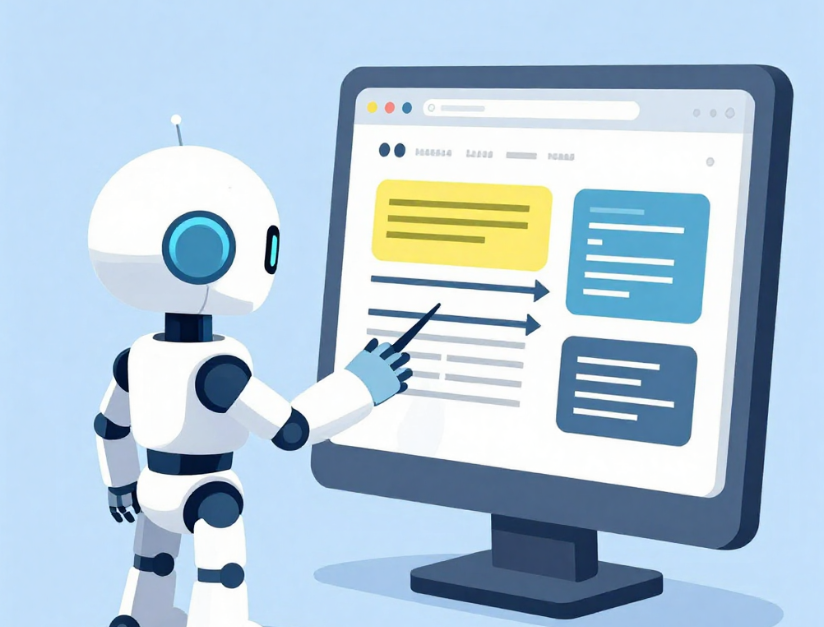
AI does not see your design.
It reads:
- tags
- headings
- hierarchy
- sections
- links
- and markup
Your HTML becomes the map of meaning for your content.
If that map is confusing, your page becomes unreliable.
The real problem: content without structure
Many pages look good visually but are broken for machines.
Typical problems:
- headings used only for styling
- missing or repeated H1 tags
- sections not grouped properly
- random div blocks without meaning
- important content buried deep in layout code
Humans can still read it.
AI struggles.
1. Broken heading hierarchy confuses AI understanding
AI relies heavily on heading order to understand topic flow.
A correct structure looks like this:
- one main topic (H1)
- logical subtopics (H2)
- supporting points (H3)
When you skip levels or use headings randomly, AI cannot detect:
- what is the main topic
- what is supporting information
- what is an example
This reduces content clarity.
And low clarity means low trust.
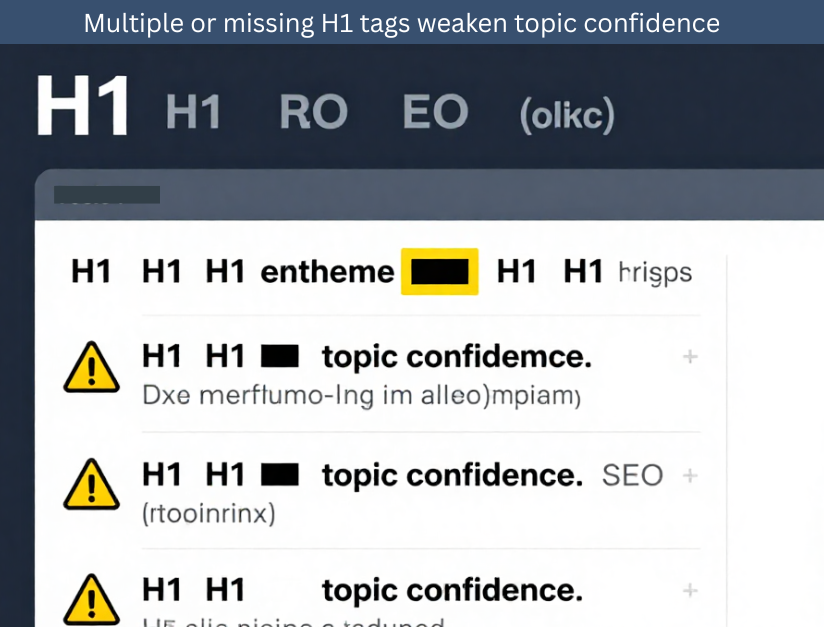
2. Multiple or missing H1 tags weaken topic confidence
Your H1 defines the main intent of the page.
When:
- there is no H1
- or there are multiple H1s for different ideas
AI cannot confidently determine the page purpose.
This creates uncertainty.
Uncertain pages are rarely used as answer sources.
3. Layout-first HTML hides meaning from AI
Many websites are built with:
- nested divs
- heavy page builders
- visual components
- dynamic containers
But without meaningful structure.
If content is wrapped only for design and not for semantics, AI sees:
- large blocks
- mixed topics
- no clear boundaries
It becomes harder to isolate answers.
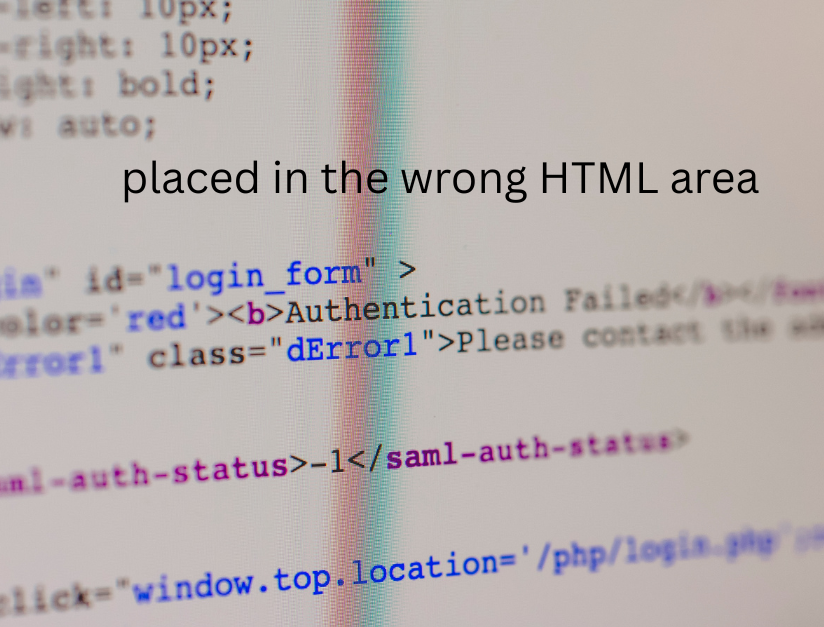
4. Important content placed in the wrong HTML area
AI expects important information to appear inside:
- proper sections
- visible content blocks
- logical containers
When key content is placed:
- inside sliders
- inside hidden tabs
- inside expandable UI elements
- or loaded late by scripts
AI may:
- devalue it
- misinterpret it
- or skip it completely
This directly reduces trust in that content.
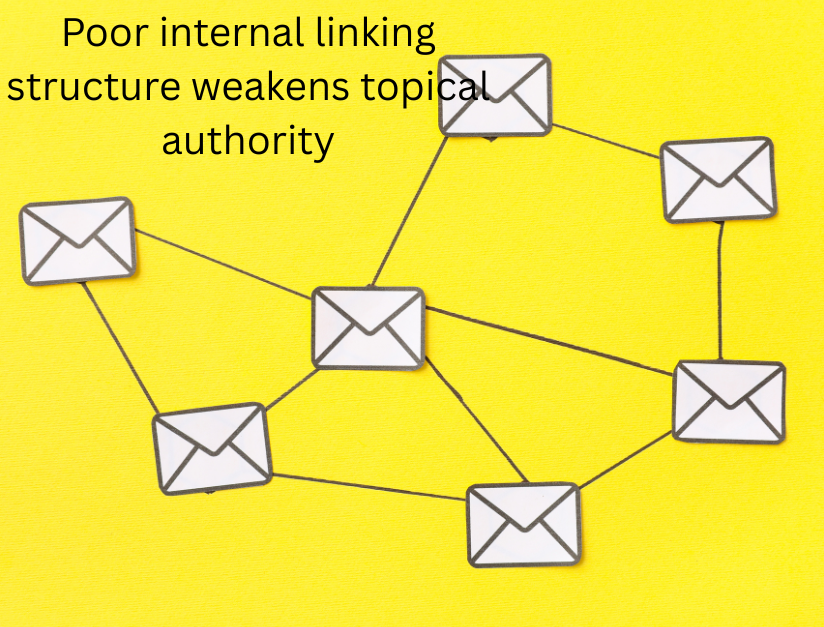
5. Poor internal linking structure weakens topical authority
HTML structure also includes how pages connect.
When links are:
- scattered randomly
- not grouped by topic
- missing descriptive anchor context
AI cannot clearly understand:
- which pages support which topic
- which page is authoritative
This reduces your site’s overall topical strength.
6. Missing semantic elements remove meaning signals
Modern HTML provides elements that give meaning, not design.
When pages do not use proper:
- sections
- headers
- articles
- navigation areas
AI must guess the role of each block.
Guessing increases uncertainty.
Uncertainty reduces trust.
7. Poor structure blocks answer extraction
AI extracts answers by isolating:
- short definitions
- clear steps
- focused explanations
If your HTML structure merges:
- multiple topics in one block
- steps mixed with marketing text
- explanations mixed with unrelated content
AI cannot safely extract a clean answer.
Even if your writing is excellent.

Why this matters more than keywords now
Traditional SEO cared about:
- keywords
- density
- placement
AI search cares more about:
- how meaning is organised
- how ideas are separated
- how answers are isolated
- how context is preserved
HTML structure is what enables all of that.
The real reason poor HTML reduces AI trust
It is not a technical problem.
It is a confidence problem.
Poor HTML makes AI unsure about:
- topic boundaries
- content priority
- answer reliability
- and page intent
And AI systems do not cite content they are unsure about.
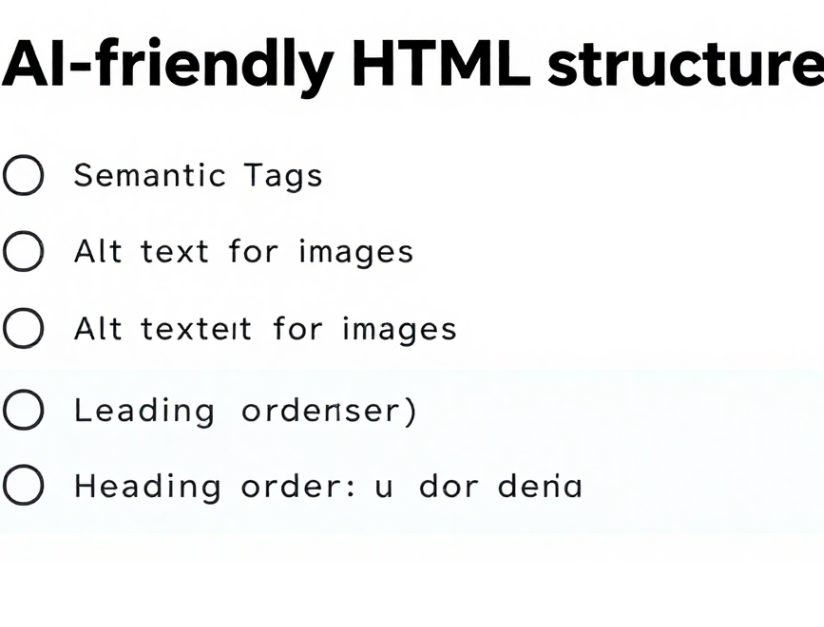
A simple AI-friendly HTML structure checklist
Use this as a practical reference for your pages:
- One clear H1 per page
- H2 sections aligned with real subtopics
- H3 only when expanding a specific H2
- Separate each idea into its own content block
- Avoid mixing multiple topics inside one section
- Place important answers in visible, static content
- Use descriptive internal links between related pages
Important note for agency and service websites
For SEO agencies and service brands like yours, this matters even more.
Because your pages are not only informational.
They represent your expertise.
If your HTML structure is weak, AI systems struggle to:
- understand your service focus
- identify your authority areas
- and connect your pages into one trusted topic cluster
Final takeaway
Poor HTML structure does not directly “break SEO”.
It breaks AI understanding.
And when AI cannot clearly understand your content, it cannot trust it enough to use it as an answer.
In modern search, visibility starts with structure — not keywords.
AI search trust means the confidence AI systems have in your page structure, clarity and content organization before using it as a source for AI-generated answers.
HTML structure helps AI understand page hierarchy, topic boundaries and content priority, which directly affects whether answers can be extracted reliably.
Yes. Even high-quality content can be ignored by AI if headings, sections and layout are not clearly structured in the HTML.
Yes. Correct H1, H2 and H3 hierarchy helps AI identify the main topic and supporting sections, improving answer extraction and topic understanding.
Yes. Multiple H1 tags for different topics make page intent unclear and reduce AI confidence in the page’s main purpose.
For AI search systems, structure and clarity are often more important than keyword usage because AI focuses on meaning and answer quality.
Yes. Clear internal linking helps AI understand topic relationships and strengthens your site’s topical authority.