
Modern websites increasingly rely on heavy JavaScript frameworks to deliver fast and interactive user experiences.
However, with AI-driven search systems now shaping how content is discovered and reused, JavaScript-heavy websites face a new and often underestimated challenge.
For service-based businesses and agencies such as Mag Cloud Solutions, understanding how AI search evaluates JavaScript-rendered pages is critical for maintaining visibility and long-term authority.
This article explains how AI search systems interpret JavaScript-driven websites, where the risks exist, and what must change in technical and on-page strategy.
How AI search systems actually read web pages
AI search platforms such as those operated by Google do not view a page the way users do in a browser.
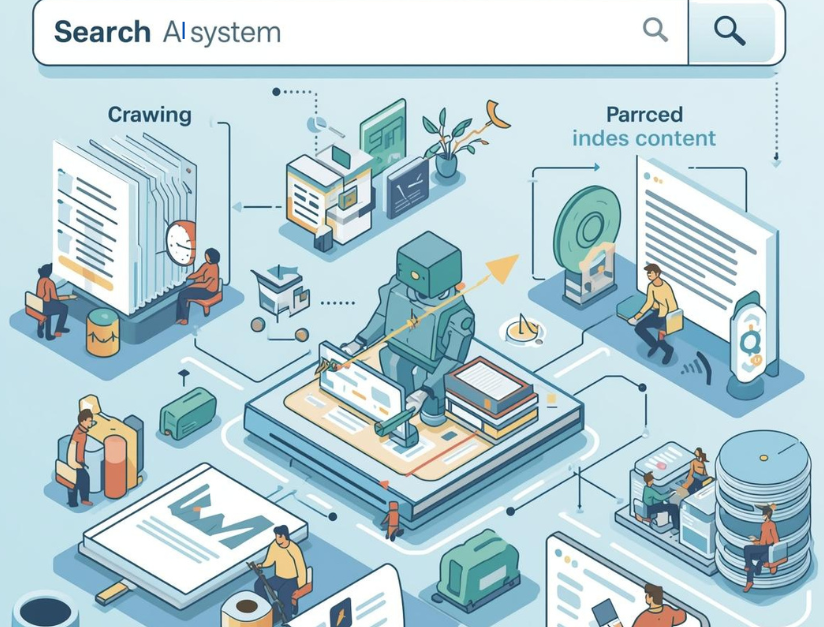
Before any content can be evaluated, the system must:
- fetch the page,
- render the HTML,
- process JavaScript execution,
- and finally extract meaningful content blocks.
Only after this technical stage can the AI layer begin analysing structure, intent and answer quality.
When a website depends heavily on client-side JavaScript to generate or reveal its main content, the reliability of this process becomes significantly weaker.
Why JavaScript-heavy websites create risk in AI search
JavaScript itself is not a ranking penalty.
The problem lies in how AI systems interpret content that appears only after scripts execute.
In AI-driven search, the priority is not only indexability but also answer reliability.
If essential content is delayed, conditionally loaded or assembled dynamically, the AI system may struggle to determine which information represents the primary topic of the page.
This uncertainty directly affects whether the page can be used as a trusted source for AI-generated answers.

Rendering delays reduce content confidence
Many JavaScript frameworks load the core layout first and inject real content later through API calls.
From an AI processing perspective, this introduces two major risks:
First, content may not be available at the moment the page is rendered for analysis.
Second, the structure of the page may appear fragmented or incomplete.
When AI systems cannot consistently render the same content structure, confidence in that page declines.
Low confidence pages are far less likely to be selected as reference sources in AI answers and summaries.
Dynamic layouts weaken structural signals
AI search relies heavily on page structure to understand meaning.
Headings, sections and content hierarchy act as signals that help the system identify definitions, explanations and procedural steps.
JavaScript-heavy layouts often create structure visually but not semantically.
Large numbers of generic container elements and dynamically injected sections make it difficult for AI systems to recognise topic boundaries and relationships.
When structural clarity is weak, even high-quality content becomes harder to interpret and reuse.

Content hidden behind interactions is less reliable
Modern websites frequently hide important information behind:
- accordions,
- tabs,
- sliders,
- and conditional UI components.
Although this improves user experience, it introduces ambiguity for AI systems.
When essential explanations or service details are not clearly visible in the initial rendered HTML, AI search may treat them as secondary or optional content.
As a result, these sections are less likely to be extracted as authoritative answers.
JavaScript-based routing complicates page identity
Single-page applications often rely on JavaScript routing rather than traditional server-side URLs.
From an AI perspective, this can cause difficulties in determining:
- which URL represents a stable content resource,
- whether the page has a persistent topic focus,
- and how that page should be connected within the broader site structure.
Clear and consistent page identity is critical when AI systems attempt to map topical authority across a website.

Internal linking becomes less visible to AI
Internal linking is a major context signal for AI search.
It helps systems understand how topics relate and which pages support core services.
On JavaScript-heavy websites, internal links are sometimes created dynamically after page load or triggered by user actions.
If those links are not present in the rendered HTML, AI systems may fail to detect important relationships between pages.
This reduces the site’s perceived topical depth and authority.
Server-side rendering and pre-rendering now matter more
To reduce uncertainty, many modern websites adopt:
- server-side rendering (SSR), or
- static pre-rendering for key pages.
These approaches ensure that meaningful HTML content, headings and links are immediately available without requiring extensive client-side execution.
For AI search systems, this significantly improves:
- content consistency,
- structural clarity,
- and extraction reliability.
In the AI search era, rendering strategy has become a visibility factor rather than only a performance decision.

JavaScript does not block indexing, but it affects answer eligibility
It is important to clarify a common misconception.
AI search systems can index JavaScript-generated content.
The risk is not indexing failure.
The real issue is answer eligibility.
If content cannot be:
- reliably rendered,
- clearly structured,
- and consistently isolated into clean informational blocks,
AI systems will avoid using that content as a source for generated answers.
In practice, this creates a visibility gap between JavaScript-heavy websites and structurally clean, server-rendered websites.
Why this matters for service-based websites
For service businesses, websites are not only marketing platforms.
They are reference sources that explain:
- how services work,
- what processes are followed,
- and which industries are supported.
When AI search evaluates such websites, it prioritises pages that:
- explain services clearly,
- show stable structure,
- and demonstrate topical authority.
JavaScript-heavy implementations that hide or dynamically construct this information weaken the site’s ability to communicate expertise to AI systems.
This directly affects the likelihood of being recommended inside AI answers.

How JavaScript-heavy websites should adapt
Websites built with modern frameworks do not need to abandon JavaScript.
They need to change how critical content is delivered.
The most effective adaptations include:
- ensuring core content is available in rendered HTML,
- preserving clean and meaningful heading hierarchy,
- avoiding placing essential explanations exclusively inside interactive components,
- providing stable internal links in the rendered output,
- and pre-rendering or server-rendering important service and informational pages.
These changes improve not only crawl reliability but also AI interpretation quality.
Final takeaway
JavaScript-heavy websites are not inherently incompatible with AI search.
However, they introduce structural and rendering uncertainty that directly impacts whether AI systems can trust and reuse their content.
In the AI search era, visibility depends less on how advanced your front-end technology is and more on how clearly your website communicates meaning, structure and expertise to machines.
For modern SEO, performance, design and interaction must be aligned with one fundamental requirement:
AI must be able to understand your content as easily as your users do.

JavaScript-heavy websites can face AI search visibility issues when important content is rendered late, dynamically injected or hidden behind interactions, making it harder for AI systems to extract reliable answers.
Yes, AI search engines can index JavaScript-generated content, but unreliable rendering and unclear structure can reduce the chances of the content being used in AI-generated answers.
Rendering methods affect how consistently AI systems can access page content and structure. Server-side rendering and pre-rendering make important information available earlier and more reliably.
Yes, when important information is hidden inside tabs, sliders or expandable sections, AI systems may treat it as secondary content and avoid using it for answers.
JavaScript frameworks often create visual layouts without strong semantic structure, which makes it difficult for AI systems to identify headings, sections and topic boundaries.
Yes, they can appear if core content is clearly rendered in HTML, structured properly with headings and sections, and consistently accessible without heavy client-side execution.
In most cases, server-side rendering improves AI interpretation because it provides complete content and structure immediately, reducing uncertainty during content extraction.
The biggest risk is not indexing, but reduced eligibility to be used as a trusted source for AI-generated answers due to unstable rendering and weak structural signals.