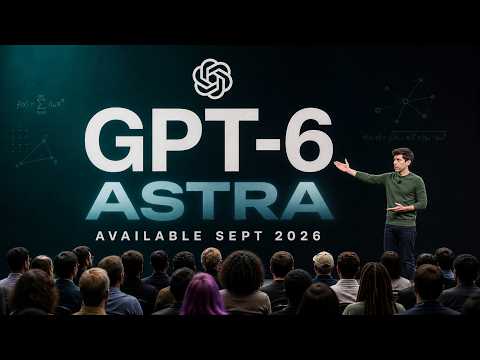
Artificial intelligence is evolving rapidly, and OpenAI has introduced another major step forward with GPT-6 Astra, its newest flagship AI model. Designed for complex reasoning, coding, computer use, cybersecurity, scientific research, and professional work, Astra represents a significant expansion of what AI assistants can do.
Unlike earlier generations that were primarily focused on answering questions and generating content, GPT-6 Astra is designed to handle more complex, multi-step tasks and work with tools such as web browsing, computer interfaces, files, and software development environments.
OpenAI describes GPT-6 Astra as its most capable model to date, with improvements across reasoning, software engineering, computer use, science, and professional workflows.
So, what exactly is GPT-6 Astra, and why is it important? Let’s take a closer look.
What Is GPT-6 Astra?
GPT-6 Astra is OpenAI’s latest generation of artificial intelligence model and the flagship model behind some of the company’s newest ChatGPT capabilities.
The model is designed to perform complex tasks that require multiple steps rather than simply responding to a single question.
For example, instead of only explaining how to solve a programming problem, an advanced AI system can potentially analyze project files, understand the existing codebase, identify problems, make changes, test the result, and help complete the development workflow.
OpenAI says Astra is particularly capable in areas including:
- Complex reasoning
- Software development
- Computer use
- Web browsing
- Scientific research
- Cybersecurity
- Professional knowledge work
- Multi-step agentic tasks
The model is also available through OpenAI’s API and can be used by developers to build AI-powered applications and workflows.
Why Is Astra Different From Previous AI Models?
One of the biggest changes is the move toward AI that can perform tasks, rather than simply generate responses.
Traditional AI assistants generally follow a simple pattern:
User asks a question → AI generates an answer
More advanced AI agents can work through a longer process:
Goal → Planning → Research → Tool use → Reasoning → Action → Result
This difference becomes important for businesses and developers.
For example, a developer could potentially use an AI agent to analyze a software project, investigate an issue, make changes, and test the implementation instead of manually handling every step.
OpenAI says Astra has been developed specifically for demanding professional and technical work.
Astra and Software Development
Software development is one of the areas where Astra is expected to have a major impact.
Modern software projects can contain thousands or even millions of lines of code. Understanding a large codebase requires context, reasoning, debugging, and the ability to work across multiple files.
OpenAI’s API documentation lists Astra as its flagship model for complex reasoning and coding. The model supports tools including functions, web search, file search, and computer use.
Developers can use AI models like Astra for tasks such as:
- Writing code
- Debugging applications
- Reviewing code
- Explaining complex programming concepts
- Refactoring existing code
- Working with APIs
- Analyzing project files
- Generating tests
- Investigating technical problems
- Assisting with software architecture
This doesn’t mean developers disappear. Instead, AI can become another development tool that helps programmers work through repetitive and complex tasks more efficiently.
Astra and Computer Use
Another important capability is computer use.
Instead of only producing text, advanced AI systems can interact with computer environments and applications.
This can make AI useful for workflows involving websites, software interfaces, files, and other digital tools.
For businesses, this could eventually enable automation of tasks that previously required someone to manually interact with multiple applications.
For example:
Open Website → Find Information → Analyze Data → Update Spreadsheet → Send Report
A capable AI agent can potentially coordinate multiple steps in a workflow.
OpenAI says Astra has been tested extensively in browsing and professional computer environments, including its ability to avoid unauthorized transactions, data loss, excessive access, and other potentially destructive actions.
Astra for Business Automation
The combination of reasoning, tool use, and computer interaction could make Astra particularly interesting for businesses.
Imagine a company receiving hundreds of customer enquiries every day.
An AI-powered workflow could potentially:
- Receive a customer enquiry.
- Understand the customer’s request.
- Extract important information.
- Check relevant business data.
- Categorize the enquiry.
- Prepare a response.
- Update the CRM.
- Notify the appropriate team member.
This is where AI and workflow automation platforms such as n8n can become especially interesting.
Businesses could combine AI models with existing applications, APIs, databases, CRM platforms, email systems, and automation tools to create more intelligent workflows.
Astra and Scientific Research
Another major area is scientific and mathematical reasoning.
OpenAI says Astra achieved a 98% score on FrontierMath Tier 4 and a 99.9% score on ARC-AGI-3 in its reported evaluations. OpenAI also says Astra has helped solve long-standing open problems in mathematics.
These results are notable because advanced reasoning is important for scientific discovery and research.
AI systems can potentially help researchers:
- Analyze large amounts of information
- Explore mathematical problems
- Generate hypotheses
- Write and analyze code
- Review research materials
- Process scientific data
- Assist with simulations and experiments
However, benchmark results should not be interpreted as proof that AI can independently solve every real-world scientific problem. Real research still requires validation, experimentation, expert judgment, and reproducibility.
Astra and Cybersecurity
Cybersecurity is another area where Astra has attracted significant attention.
OpenAI says GPT-6 Astra is its first model to reach the Critical level of cybersecurity capability under its Preparedness Framework. According to OpenAI, with appropriate tools and access, Astra can identify previously unknown security flaws and develop new exploitation techniques across well-protected systems.
This capability has both defensive and security implications.
On the defensive side, powerful AI systems could help security teams identify vulnerabilities faster, analyze code, test systems, and improve security.
At the same time, the same capabilities could create risks if misused.
Because of this, OpenAI says it has implemented stronger monitoring, isolated testing environments, restricted network and tool access, sandboxed execution, and additional security controls around Astra.
Astra’s Context Window
Another important technical feature is Astra’s large context window.
OpenAI’s API documentation lists a 1.05 million token context window and a maximum output of 128,000 tokens for GPT-6 Astra.
A large context window allows an AI model to work with significantly more information in a single task.
This can be useful when working with:
- Large documents
- Software projects
- Research materials
- Business reports
- Multiple files
- Long conversations
- Large datasets
For developers, this can be particularly useful when an AI needs to understand information spread across many files or documents.
Is GPT-6 Astra Available in ChatGPT?
OpenAI announced that GPT-6 Astra began rolling out to a limited set of organizations and would subsequently become available to ChatGPT Plus, Pro, Business, and Enterprise users, as well as through the OpenAI API, Microsoft Azure, and AWS Bedrock.
Availability and usage limits can vary depending on the product and subscription.
OpenAI’s current documentation also identifies Astra as its flagship model for complex reasoning and coding.
What Does Astra Mean for the Future of AI?
GPT-6 Astra represents a broader shift in artificial intelligence.
The industry is moving from AI that primarily generates information toward AI systems that can increasingly reason, use tools, interact with computers, and complete multi-step workflows.
This could change how people use AI at work.
Instead of asking:
“Write this report for me.”
Users may increasingly ask:
“Research this topic, analyze the available information, prepare the report, organize the data, and create the final document.”
That represents a shift from AI as a simple chatbot to AI as a more capable digital work assistant.
However, human oversight will remain important, especially for tasks involving sensitive information, financial decisions, cybersecurity, legal matters, and other high-impact areas.
Final Thoughts
GPT-6 Astra is an important development in the evolution of AI assistants.
Its capabilities in reasoning, coding, computer use, research, and tool-based workflows demonstrate how AI systems are becoming increasingly capable of handling complex tasks.
For developers, Astra could become a powerful coding and research assistant. For businesses, it could enable more sophisticated automation and AI-powered workflows. For researchers, it could provide assistance with complex scientific and mathematical problems.
At the same time, greater capability also creates greater responsibility. OpenAI’s own safety documentation highlights the need for stronger safeguards, particularly because Astra has reached a new level of cybersecurity capability.
The most important change may not simply be that AI can generate better answers. The bigger change is that AI is increasingly becoming capable of working through problems, using tools, and helping complete real-world tasks.
As these systems continue to develop, the way businesses, developers, researchers, and everyday users interact with technology could change significantly.