Artificial Intelligence (AI) is rapidly changing the way businesses operate, and the retail industry is one of the biggest areas experiencing this transformation. From personalized product recommendations to automated customer support and intelligent inventory management, AI is helping retailers improve efficiency, understand customers, and create better shopping experiences.
In 2026, AI is no longer simply an experimental technology for large companies. Retail businesses of different sizes are adopting AI-powered tools to automate repetitive tasks, analyze large amounts of data, improve decision-making, and provide more personalized services.
As competition in the retail market continues to increase, businesses that understand how to use AI effectively can improve their operations while creating a more convenient experience for customers.
What Is AI in Retail?
AI in retail refers to the use of artificial intelligence technologies to perform tasks that traditionally require human decision-making and analysis. These technologies can process large amounts of information, identify patterns, make predictions, and automate certain business processes.
Retailers can use AI across different areas of their business, including ecommerce, physical stores, marketing, customer service, inventory, pricing, logistics, and payments.
For example, an ecommerce website can use AI to recommend products based on a customer’s previous purchases and browsing behavior. Similarly, a retailer can use AI to predict which products are likely to sell faster and adjust inventory accordingly.
1. Personalized Shopping Experiences
One of the most visible applications of AI in retail is personalization.
Modern customers expect shopping experiences that are relevant to their interests. AI can analyze customer behavior, purchase history, searches, product views, and other interactions to understand individual preferences.
Based on this information, retailers can provide personalized product recommendations, offers, email campaigns, and website content.
For example, when a customer visits an online clothing store, an AI-powered recommendation system may suggest products based on the customer’s previous purchases, preferred styles, or recently viewed items.
Personalization can make it easier for customers to discover relevant products while helping retailers improve customer engagement and sales opportunities.
2. Smarter Inventory Management
Inventory management is one of the most important challenges for retail businesses.
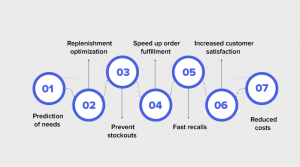
Keeping too much inventory can increase storage costs, while keeping too little can result in stockouts and missed sales. AI can help retailers analyze historical sales, seasonal demand, customer behavior, and other factors to predict future inventory requirements.
AI-powered forecasting systems can identify products that are likely to experience increased demand and help businesses plan their stock accordingly.
For example, a retailer may use historical sales data to predict increased demand for certain products during holidays, festivals, or seasonal events.
This allows businesses to make more informed inventory decisions and reduce unnecessary waste.
3. AI-Powered Customer Service
Customer service is another area where AI is having a significant impact.
AI-powered chatbots and virtual assistants can answer common customer questions at any time of the day. They can provide information about product availability, order status, delivery times, returns, and other frequently requested information.
Instead of requiring employees to answer every basic question manually, businesses can automate repetitive customer service tasks.
More advanced AI systems can also understand natural language and provide more conversational responses.
However, human support remains important for complex issues. A practical approach is to use AI for routine requests while allowing customers to connect with human representatives when necessary.
4. Better Product Recommendations
Product recommendation systems have become an important part of ecommerce.
AI can analyze customer behavior and identify relationships between different products. It can then recommend products that customers may be interested in.
For example, an online electronics store may recommend a phone case, charger, or screen protector when a customer views a smartphone.
These recommendations can appear on product pages, shopping carts, homepages, and marketing emails.
The goal is not simply to display more products but to make product discovery more relevant to each customer.
5. Dynamic Pricing and Better Offers
Pricing is another area where AI can support retail decision-making.
Retail businesses can use AI to analyze factors such as demand, inventory levels, competitor pricing, seasonal trends, and customer behavior.
This information can help businesses determine when certain products may require discounts or promotional offers.
For example, if demand for a product decreases while inventory remains high, an AI-powered system can identify the situation and help retailers consider an appropriate promotional strategy.
AI does not necessarily replace human decision-making. Instead, it provides data-driven insights that can help retailers make pricing decisions more efficiently.
6. AI in Physical Retail Stores
AI is not limited to online shopping.
Physical retail stores are also adopting technologies such as computer vision, smart cameras, intelligent checkout systems, and automated inventory monitoring.
Computer vision can help retailers monitor product shelves, identify missing products, and understand customer movement within stores.
Smart checkout systems can also reduce waiting times by automating parts of the checkout process.
These technologies can help stores improve operational efficiency while allowing employees to spend more time assisting customers.
7. AI and Retail Marketing
Marketing teams generate and manage large amounts of customer and campaign data.
AI can help retailers analyze this information and identify patterns that may not be immediately visible through manual analysis.
Retailers can use AI to segment customers, personalize marketing messages, generate content ideas, analyze campaign performance, and identify potential customer interests.
For example, an online retailer can use customer behavior data to create different marketing campaigns for new customers, repeat buyers, and inactive customers.
This allows businesses to move away from one-size-fits-all marketing and develop more targeted communication.
8. AI for Fraud Detection and Security
Security is another important application of AI in retail.
Online retailers process payments, customer accounts, addresses, and other sensitive information. Fraudulent transactions can create financial losses and damage customer trust.
AI systems can analyze transactions and identify unusual patterns that may indicate fraudulent activity.
For example, a system may detect an unusual combination of purchasing behavior, location, device information, or transaction patterns and flag the activity for additional verification.
AI can therefore become an important component of a broader retail cybersecurity strategy.
9. Faster and Smarter Delivery
Customers increasingly expect fast and reliable delivery.
AI can help retailers and logistics companies improve delivery operations by analyzing orders, inventory locations, traffic information, and delivery patterns.
AI-powered systems can help businesses determine how products should be stored and how orders can be processed more efficiently.
Better demand forecasting can also help retailers position inventory closer to customers, potentially reducing delivery times.
For ecommerce businesses, these improvements can contribute to a smoother overall customer experience.
10. The Growth of AI-Powered Shopping Assistants
AI shopping assistants are becoming another important development in retail.
Instead of simply searching for a product using keywords, customers can describe what they need in natural language.
For example, a customer could ask an AI assistant to help find a laptop suitable for office work, a particular budget, and specific requirements.
The system can then help narrow down suitable products and provide information based on the customer’s requirements.
This creates a more conversational approach to online shopping.
Challenges of Using AI in Retail
Although AI provides many opportunities, implementing it also comes with challenges.
Data privacy is an important consideration because AI systems often rely on customer information. Retailers need to handle customer data responsibly and follow applicable privacy and security requirements.
Another challenge is data quality. AI systems depend on accurate and useful data. Poor-quality or incomplete information can result in unreliable insights.
Businesses may also need to invest in technology infrastructure, employee training, cybersecurity, and integration with existing systems.
For these reasons, retailers should approach AI implementation strategically rather than adopting technology simply because it is trending.
The Future of AI in Retail
The role of AI in retail is expected to continue expanding.
AI will increasingly become part of everyday retail operations, from inventory planning and customer service to marketing, payments, logistics, and ecommerce.
The next stage of retail AI is likely to involve more connected systems that can work together rather than isolated AI tools.
For example, customer behavior data could influence product recommendations, inventory planning, marketing campaigns, and customer service at the same time.
Retail businesses will also need to focus on responsible AI adoption, data security, transparency, and human oversight.
Conclusion
AI is transforming the retail industry by helping businesses understand customers, automate repetitive tasks, improve inventory management, personalize shopping experiences, and make more informed decisions.
In 2026, retailers do not need to replace their entire business infrastructure to benefit from AI. They can start with practical applications such as customer service chatbots, product recommendations, inventory forecasting, marketing automation, or fraud detection.
The key is to identify areas where AI can solve genuine business problems and then implement the technology carefully.
As retail continues to become more digital and customer expectations continue to evolve, AI will remain an important technology for businesses looking to improve efficiency and deliver more relevant shopping experiences.