
Search engines have evolved dramatically over the past decade. Earlier, search engines relied mainly on matching keywords to determine which pages should appear in search results. Today, artificial intelligence plays a major role in understanding websites and evaluating their content.
Modern AI systems analyze webpages in a much deeper way. Instead of only scanning keywords, they interpret context, structure, meaning, and user behavior. This allows search engines to deliver more relevant results to users.
Understanding how AI reads website content can help website owners and digital marketers create content that is easier for search engines to understand and rank.
The Evolution of Search Engines
In the early days of SEO, ranking a webpage was often achieved by repeating keywords multiple times in the content. This technique, known as keyword stuffing, was widely used to manipulate rankings.
However, search engines quickly realized that this approach did not always provide useful results to users. As a result, they began developing smarter algorithms capable of understanding content more intelligently.
Artificial intelligence and machine learning now help search engines analyze webpages in ways that are closer to how humans understand information.
How AI Processes Website Content
When a search engine discovers a webpage, AI systems begin analyzing different elements of the page to understand its meaning and relevance.
Several key factors help AI interpret website content.
Content Structure
AI pays close attention to the structure of a webpage. Well-organized content makes it easier for search engines to understand the main topic and supporting information.
Important structural elements include:
- Page titles
- Headings and subheadings
- Paragraph organization
- Lists and sections
A clear structure allows AI systems to identify the hierarchy of information and determine the importance of different sections of a page.
Context and Meaning
Modern AI systems analyze the context of words rather than focusing only on individual keywords.
For example, if a webpage discusses “digital marketing strategies,” AI will also recognize related concepts such as SEO, social media marketing, content marketing, and online advertising.
By understanding the relationships between these terms, AI can determine the overall topic of the page more accurately.
Natural Language Understanding
Artificial intelligence uses natural language processing to interpret human language. This technology helps search engines analyze sentences, grammar, and meaning.
Instead of simply identifying keywords, AI evaluates how words are used together within a sentence. This allows search engines to understand conversational queries and longer search phrases.
Natural language understanding has made it possible for search engines to deliver results that match the user’s intent more effectively.
Topic Relevance
AI systems also analyze whether a webpage provides comprehensive coverage of a topic. Pages that discuss a subject in depth are often considered more valuable than pages that provide only basic information.
For example, a detailed article about website speed optimization might include topics such as image compression, caching, hosting performance, and code optimization.
Covering related topics helps search engines understand that the page offers a complete explanation of the subject.
Internal and External Links
Links play an important role in how AI evaluates webpages.
Internal links connect related pages within a website and help search engines understand the structure of the site. They also show how different topics are connected.
External links, especially from reputable websites, signal that the content may be trustworthy and valuable.
AI analyzes these links to determine the authority and credibility of a webpage.
User Engagement Signals
Search engines also observe how users interact with webpages.
If users spend time reading a page, explore other pages on the website, or return to the site later, it suggests that the content is helpful.
On the other hand, if users quickly leave a page, it may indicate that the content did not meet their expectations.
These engagement signals help AI systems learn which pages provide the best experience for users.
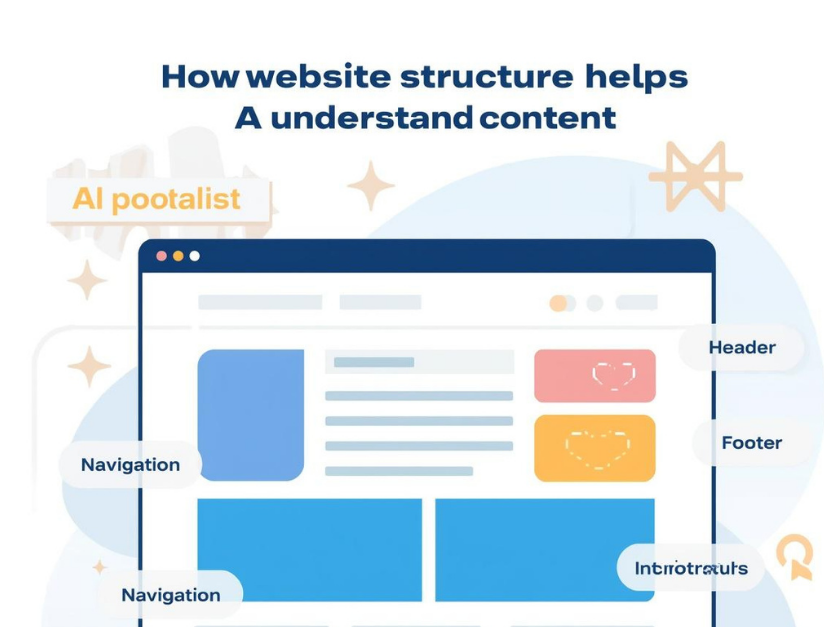
The Role of Website Structure in AI Understanding
A well-structured website helps AI systems navigate and analyze content more efficiently.
Some important structural elements include:
- Clear navigation menus
- Logical page hierarchy
- Organized categories
- Consistent URL structure
When a website is organized properly, search engines can crawl and index its pages more effectively.
Why High-Quality Content Matters
Artificial intelligence is designed to prioritize helpful and informative content. Websites that provide valuable insights and accurate information are more likely to perform well in search results.
High-quality content typically includes:
- Clear explanations
- Useful examples
- Well-organized sections
- Relevant supporting information
Content that focuses on user needs rather than search engine manipulation is more likely to be recognized as valuable by AI systems.
Best Practices to Help AI Understand Your Content
Website owners can take several steps to ensure their content is easy for AI systems to interpret.
Use clear headings
Headings help search engines understand the structure and key points of a page.
Write naturally
Content should be written for readers rather than for algorithms.
Organize information logically
Break content into sections to make it easier to read and analyze.
Include related topics
Covering connected ideas helps search engines understand the depth of your content.
Maintain consistent quality
Publishing helpful and accurate content regularly builds trust with search engines.
The Future of AI in Search
Artificial intelligence will continue to improve how search engines evaluate content. Future developments may include deeper understanding of context, improved voice search interpretation, and better recognition of expert knowledge.
As search technology evolves, the focus will remain on providing users with the most helpful and relevant information.
Websites that prioritize clarity, usefulness, and user experience will continue to benefit from these advancements.
Final Thoughts
Artificial intelligence has transformed how search engines read and evaluate website content. Instead of relying only on keywords, modern AI systems analyze structure, context, relevance, and user engagement.
For website owners and digital marketers, the key to success is creating content that genuinely helps readers while maintaining a clear and organized structure.
When content is easy to understand and provides real value, AI systems can interpret it effectively and reward it with better visibility in search results.
FAQS
AI analyzes webpage text, headings, links, and structure to understand the topic and context of the content.
Clear headings, well-structured content, relevant keywords, and internal links help AI interpret webpages more effectively.
No. Modern AI systems analyze context, topic relevance, and relationships between words rather than focusing only on keywords.
A clear structure helps search engines understand the hierarchy of information and improves readability for users.
Yes. AI systems evaluate content quality based on factors like relevance, depth, accuracy, and user engagement.