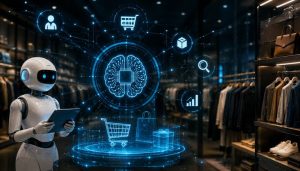

Artificial Intelligence has already changed the way people search for products, communicate with businesses, and make purchasing decisions. In 2026, the next major development in retail technology is the growth of Agentic AI.
Unlike traditional AI tools that mainly respond to individual requests, AI agents can be designed to understand goals, make decisions, complete multiple steps, and interact with different digital systems. This has the potential to change how customers shop and how retailers manage ecommerce operations.
From finding products and comparing options to managing orders and providing customer support, AI agents are becoming an important area of innovation for the retail industry.
What Is Agentic AI?
Agentic AI refers to AI systems that can perform a sequence of tasks to achieve a particular goal with limited human intervention.
A traditional chatbot might answer a question such as, “Do you have this product in stock?”
An AI agent could potentially take a broader instruction such as, “Find me a suitable laptop for office work within my budget,” and then search available products, compare specifications, check relevant information, and help the customer move toward a purchase.
The important difference is that agentic systems are designed around goals and actions, rather than simply generating individual responses.
How Agentic AI Can Change Online Shopping
Online shopping currently requires customers to perform many individual actions.
A customer may need to search for products, open multiple product pages, compare prices, check reviews, select a suitable option, add it to a cart, enter delivery information, and complete payment.
AI agents could make this process more conversational and automated.
Instead of navigating through many pages, customers could explain what they are looking for and allow an AI-powered shopping assistant to help complete several parts of the process.
For example, a customer might say:
“I need running shoes for regular outdoor running. Find options within my budget and show me the most suitable choices.”
An AI agent could use the customer’s requirements to identify relevant products and provide a more personalized shopping experience.
1. AI Shopping Assistants
One of the most important applications of agentic AI is the AI shopping assistant.
Traditional search systems generally depend on keywords. Customers enter a product name and receive a list of results.
AI shopping assistants can understand more detailed natural-language requests.
Customers can describe their requirements, preferences, budget, intended use, or other conditions.
For retailers, this creates an opportunity to build a more interactive product discovery experience.
Instead of simply displaying thousands of products, an AI assistant can help customers narrow down their choices.
2. Automated Product Discovery
Finding the right product can sometimes be difficult, especially when an ecommerce store has a large catalog.
AI agents can analyze product information and customer requirements to identify relevant products.
For example, a customer shopping for home office equipment may need a desk, chair, monitor, keyboard, and other accessories.
An AI-powered system could understand the broader requirement and help the customer discover related products.
This can also help retailers create opportunities for cross-selling and product discovery.
3. Personalized Recommendations
Personalization has already become an important part of ecommerce, but agentic AI can make recommendations more interactive.
Instead of automatically displaying recommendations based only on previous purchases, an AI agent can ask questions and use the customer’s responses to understand their current needs.
For example, a customer who previously purchased casual clothing may now be looking for formal wear.
An AI agent can consider the current request rather than relying entirely on historical behavior.
This can make recommendations more relevant to the customer’s immediate shopping goal.
4. Comparing Products
Customers often spend significant time comparing products.
They may need to compare price, specifications, features, availability, warranty information, delivery options, and customer reviews.
An AI shopping agent can help organize this information into a simpler comparison.
For example, if a customer is choosing between several smartphones, the AI assistant could explain the major differences based on the customer’s priorities.
This can make the decision-making process easier without requiring customers to manually open numerous product pages.
5. Improving Customer Support
Agentic AI can also change how retailers provide customer support.
Traditional customer support systems often require customers to contact an employee for many common requests.
AI agents can potentially handle tasks such as checking order status, answering product questions, explaining return policies, and providing basic delivery information.
More advanced systems may be able to perform actions across connected business platforms.
For example, instead of simply telling a customer that an order is delayed, an AI agent could access the relevant order information and provide an updated status.
Human employees can remain available for complex or sensitive cases.
6. Automated Order Management
Order management involves multiple steps, including order confirmation, inventory checks, fulfillment, shipping, tracking, and customer communication.
AI agents can potentially coordinate information across these systems.
For example, if a product becomes unavailable after an order is placed, an AI system could identify the issue and initiate an appropriate workflow based on the retailer’s rules.
The goal is to reduce manual work and help businesses respond to operational issues more quickly.
7. Agentic AI for Retail Employees
AI agents are not only useful for customers.
Retail employees can also use AI-powered assistants to complete internal tasks.
For example, a store manager could ask an AI assistant to summarize sales performance, identify low-stock products, or prepare a report.
An ecommerce manager could use AI to analyze product performance and identify items that require attention.
This allows employees to spend less time collecting and organizing information manually.
8. AI Agents and Inventory Management
Inventory management can become more complex as retailers sell through multiple channels.
A business may have products available through physical stores, its ecommerce website, marketplaces, and social commerce channels.
AI agents can help monitor inventory information across connected systems.
If inventory for a particular product is declining rapidly, an AI system can identify the situation and alert the relevant team.
When combined with forecasting systems, AI can also help retailers plan future stock requirements.
9. AI Agents in Marketing
Marketing is another area where agentic AI can automate workflows.
Retail businesses regularly need to create product descriptions, promotional messages, email campaigns, social media content, and advertising variations.
AI agents can help coordinate parts of these workflows.
For example, a retailer could provide information about a new product and use AI tools to generate initial marketing content, organize campaign information, and prepare variations for different channels.
Human review remains important to ensure that the final content is accurate and consistent with the company’s brand.
10. The Importance of Data Integration
For agentic AI to work effectively in retail, access to accurate information is essential.
Retail businesses often use multiple systems for ecommerce, inventory, CRM, payments, accounting, customer support, and logistics.
If these systems operate separately, an AI agent may not have access to the information required to complete a task.
This makes system integration an important part of AI implementation.
APIs and connected business platforms can allow AI systems to access approved information and perform specific actions according to predefined rules.
Security and Privacy Considerations
The increased use of AI agents also creates new security considerations.
An AI system that can access customer accounts, order information, inventory systems, or other business platforms needs appropriate permissions.
Businesses should carefully control what an AI agent can access and what actions it can perform.
Sensitive information should be protected, and important actions may require additional verification or human approval.
Retailers should also maintain clear policies around customer data and AI usage.
Challenges of Agentic AI in Retail
Despite its potential, agentic AI is not a simple solution for every retail business.
Implementation can require integration with existing software, reliable data, security controls, testing, and employee training.
AI systems can also make mistakes or misunderstand customer requirements.
For this reason, businesses should start with clearly defined use cases and establish appropriate human oversight.
Retailers should also measure whether an AI system is actually improving customer experience, reducing costs, or saving employee time.
The Future of Agentic AI in Retail
Agentic AI is likely to become an increasingly important part of ecommerce and retail technology.
Customers may increasingly interact with retailers through conversational interfaces instead of relying entirely on traditional website navigation.
Businesses may also use AI agents internally to automate workflows across customer service, inventory, marketing, sales, and operations.
However, the most successful implementations are likely to combine AI automation with human oversight rather than attempting to automate every decision.
Conclusion
Agentic AI represents a new stage in the evolution of retail technology.
Instead of simply answering questions, AI agents can be designed to understand goals, coordinate multiple tasks, and interact with connected business systems.
For retailers, this creates opportunities to improve product discovery, personalization, customer service, inventory management, marketing, and operational efficiency.
As the technology develops, businesses will need to focus on reliable data, strong security, clear permissions, and responsible implementation.
The future of online shopping may become less about navigating through individual pages and more about simply telling an intelligent digital assistant what you need—and allowing technology to help complete the journey.