Many businesses eventually need software that goes beyond the capabilities of a standard website. They may require customer portals, booking systems, vendor dashboards, subscription services, property platforms, or internal business management tools.
Although ready-made platforms can handle many common requirements, specialized workflows sometimes need a custom web application.
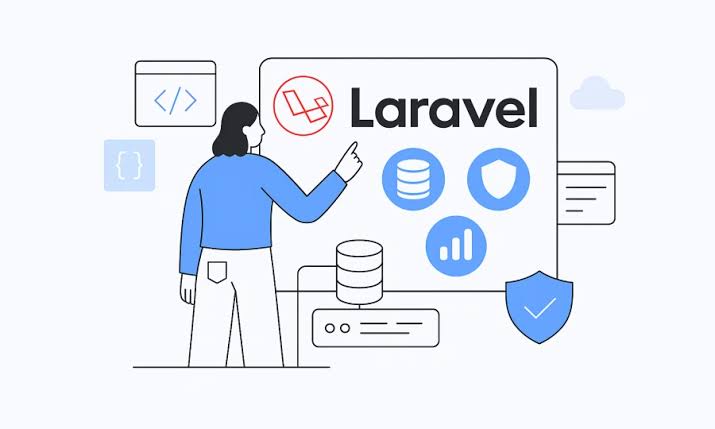
Laravel is a popular PHP framework designed to make web application development more organized and maintainable. It provides established tools for common development tasks, helping teams build applications without implementing every foundational feature from scratch.
In this guide, we explain what Laravel offers, why businesses choose it, and which factors to consider before starting a Laravel development project.
1. What Is Laravel?
Laravel is an open-source web application framework built with PHP.
A framework provides reusable components and conventions that help developers organize application code and implement common functionality.
Laravel includes routing, request validation, database tools, authentication-related capabilities, queues, caching integrations, and other development features.
Instead of writing every component independently, developers can build on the framework’s established structure.
Laravel is commonly used for:
- Business management applications.
- Customer and vendor portals.
- Booking platforms.
- Property listing websites.
- Subscription services.
- Ecommerce applications.
- CRM and administrative tools.
- REST API backends.
The framework is particularly useful when an application requires multiple connected features and ongoing development.
2. Structured and Maintainable Code
A growing application can become difficult to manage if its logic is spread across unrelated files and duplicated functions.
Laravel encourages developers to organize functionality using routes, controllers, models, middleware, services, and other components.
This structure helps developers understand where specific operations belong.
For example, a property listing application may separate responsibilities for listing management, user permissions, image uploads, payments, and search filters.
A structured codebase can make debugging, testing, and future enhancements easier.
However, a framework does not automatically guarantee clean architecture. Developers must still make sensible design decisions and avoid unnecessary complexity.
3. Database Management With Eloquent ORM
Most business applications depend on data, such as users, products, orders, appointments, or property listings.
Laravel provides Eloquent ORM, which allows developers to work with database records through models and relationships.
For example, an ecommerce application might associate customers with orders and orders with individual products.
Eloquent can simplify common database operations and make relationships easier to express.
Laravel migrations also help developers define and track database structure changes in code.
For reliable applications, developers must still understand database design, indexes, transaction handling, query efficiency, and data integrity.
A convenient ORM should not replace proper database planning.
4. Security Features for Web Applications
Business applications may handle confidential information, user accounts, payment records, and administrative operations.
Laravel provides tools that help developers implement common security requirements, but the application must be configured correctly.
Important considerations include authentication, authorization, request validation, secure password handling, and protection against common web vulnerabilities.
For example, a vendor dashboard should prevent one vendor from editing another vendor’s listings unless the application explicitly permits that action.
A secure system should verify permissions on the server rather than relying only on hidden buttons or frontend restrictions.
Developers should also protect sensitive configuration values, keep dependencies updated, and test access controls thoroughly.
5. Laravel for API Development
Modern applications often communicate with external services or frontend interfaces through APIs.
Laravel can be used to create API endpoints that exchange structured data between systems.
Examples include:
- Mobile applications communicating with a backend.
- Websites retrieving product information.
- CRM systems receiving customer inquiries.
- Payment providers sending transaction notifications.
- External platforms synchronizing inventory.
- Third-party applications accessing authorized records.
API development requires careful attention to authentication, authorization, validation, rate limits, and error responses.
Developers should also document endpoints and ensure that sensitive information is not exposed unnecessarily.
When a business depends on several integrations, API design becomes an important part of long-term application reliability.
6. Background Jobs and Workflow Processing
Some operations should not keep a user waiting for a web page to finish loading.
Examples include sending bulk notifications, generating reports, processing large files, or preparing documents.
Laravel supports queued jobs that can move suitable tasks into background processing systems.
For example, a booking platform may save a reservation immediately and process notification emails separately.
This can improve the user experience, although the queue infrastructure must be configured and monitored properly.
Failed jobs, retries, duplicate processing, and external service interruptions should all be considered when designing production workflows.
7. Building Scalable Business Applications
Businesses often want software that can support additional users and features as operations grow.
Laravel can support scalable applications, but scalability depends on the complete architecture rather than the framework alone.
Database optimization, caching, queue workers, application servers, file storage, and external dependencies all influence performance.
A small internal dashboard may work well on modest infrastructure. A high-traffic marketplace with complex searches and many simultaneous transactions may require additional architectural planning.
Developers should measure actual performance, identify bottlenecks, and scale components according to demand.
Planning for maintainability from the beginning can also reduce the cost of future enhancements.
8. Laravel vs. WordPress
Laravel and WordPress are designed for different primary purposes.
WordPress is a content management system that provides a ready-made administrative interface for pages, posts, media, and plugins.
Laravel is a development framework that gives developers more direct control over custom application logic.
WordPress is often suitable for business websites, blogs, and ecommerce projects that fit its ecosystem.
Laravel may be more appropriate when the core product requires specialized workflows, custom permissions, complex data relationships, or a tailored user experience.
Neither platform is universally better. The right choice depends on whether the business primarily needs content management or a custom application.
9. The Laravel Development Process
A successful Laravel project begins with clear requirements.
First, the development team identifies user roles, essential features, workflows, integrations, and security needs.
Next, developers design the database, application structure, and user experience.
Implementation should be followed by testing, including validation, permissions, integrations, and error handling.
Before launch, the application should be deployed to an appropriately configured environment with backups, logging, and monitoring.
After launch, the team should maintain dependencies, investigate issues, and plan enhancements based on real user feedback.
This process reduces the risk of building an application that looks complete but fails under practical conditions.
Conclusion
Laravel offers a structured foundation for building custom web applications with PHP. Its routing, database tools, validation, API capabilities, and background processing features make it suitable for many business systems.
The framework is most valuable when combined with clear requirements, thoughtful architecture, secure development practices, and ongoing maintenance.
Mag Cloud Solutions helps businesses explore custom web development solutions based on their workflows, integrations, and long-term goals.
Planning a custom Laravel application?
Contact Mag Cloud Solutions to discuss your project requirements.
Mag Cloud Solutions
Phone: +91 9536899899
Email: sales@magcloudsolutions.com
Website: https://magcloudsolutions.com/